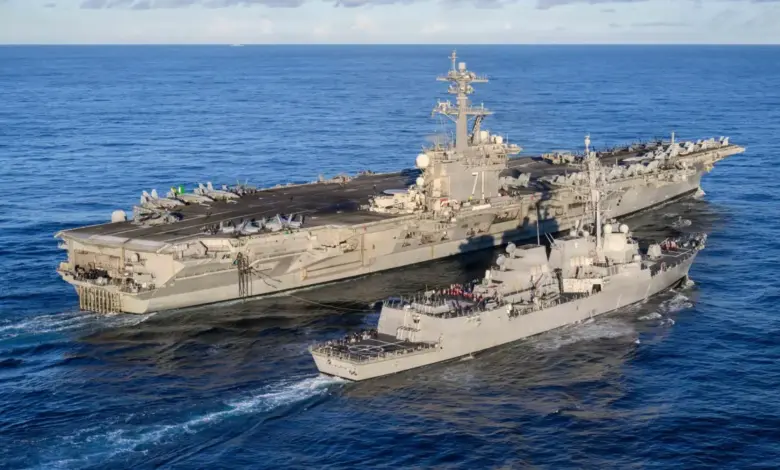
The number is not large, but the signal is: the Navy’s 2027 budget request points to rapid counter-drone funding for two carrier strike groups, and agm-114 hellfire sits at the center of that effort. The documents describe supplemental funding for the Gerald R. Ford Carrier Strike Group and the Theodore Roosevelt Carrier Strike Group, pairing Longbow Hellfire launchers with Coyote launchers and installation work. That combination suggests a fast response to a threat the Navy now treats as persistent, not theoretical.
The central question is simple: what is not being said about how quickly carrier strike groups are being reworked to meet uncrewed aerial threats, and what does that imply about the scale of the pressure on Navy defenses?
What exactly is the Navy funding in the background?
Verified fact: The Navy’s 2027 Fiscal Year budget request includes a line item saying supplemental funding was provided to rapidly field counter-uncrewed aerial systems solutions for the Gerald R. Ford Carrier Strike Group, including procurement of Longbow Hellfire launchers, Coyote launchers, and installation and integration work. The same language says funding was also provided for the Theodore Roosevelt Carrier Strike Group for Longbow Hellfire launchers, Coyote launchers, and related work.
Verified fact: The newly released budget documents also say FY2024 and FY2025 funding was used to rapidly field those same solutions for both carrier strike groups. A separate proposed budget for FY2026 includes the same line item, but does not mention the Hellfire or Coyote integration effort.
Analysis: The gap between the budget language and the absence of ship-by-ship detail matters. The Navy is acknowledging accelerated fielding, but not identifying which ships received the launchers or whether they are already installed. That restraint leaves the public with a broad picture and very little operational transparency.
Why does agm-114 hellfire matter in a carrier strike group?
Verified fact: The millimeter-wave radar-guided Longbow Hellfire, designated AGM-114L, has a demonstrated counter-drone capability and can also strike targets on land or at sea. The Navy previously announced modifications to Freedom class Littoral Combat Ships to allow them to engage uncrewed aerial threats with AGM-114Ls fired from launchers designed for those vessels.
Verified fact: Carrier strike groups normally include cruisers and destroyers, not Littoral Combat Ships. The documents do not say which ships in the Gerald R. Ford and Theodore Roosevelt groups may have received the launchers.
Analysis: The choice of agm-114 hellfire signals a preference for a weapon already described as useful against drones and surface targets. In context, it looks less like an experimental add-on and more like a practical bridge while the Navy expands shipboard defenses against uncrewed aerial threats. That is reinforced by the parallel push to install Coyote launchers on Arleigh Burke class destroyers sailing with carrier strike groups.
What do recent tests reveal about the Navy’s direction?
Verified fact: In June 2025, Naval News said two Arleigh Burke class destroyers, USS Jason Dunham and USS The Sullivans, had previously been involved in testing of new capabilities, including Longbow Hellfire in the counter-drone role. Neither ship was assigned to the Gerald R. Ford or Theodore Roosevelt carrier strike groups.
Verified fact: The Navy’s latest push also reflects a larger response to drone threats during operations in and around the Red Sea and against Iran, experiences the service says underscored the need for more shipboard defenses.
Analysis: Taken together, the budget language and testing history point to a Navy that is moving from isolated evaluation to broader fielding. The pace appears driven by operational lessons already absorbed by the service, rather than by a future threat still being modeled in theory. The result is a layered defense effort: Longbow Hellfire launchers, Coyote launchers, and integration work across carrier strike group ships.
Who benefits, who is left in the dark?
Verified fact: The Navy’s documents do not identify the ships involved, and they do not state whether the launchers are currently installed. The service has also not publicly detailed what the integration work has entailed to date. The Navy has reached out for information from Naval Sea Systems Command and Lockheed Martin, the Longbow Hellfire’s prime contractor.
Analysis: The immediate beneficiaries are obvious: carrier strike groups receive faster access to a weapon system described as capable against drones, land targets, and surface targets. The unresolved issue is accountability. When a budget request confirms rapid fielding but omits platform-level detail, the public can see that defenses are expanding, but not how complete, effective, or evenly distributed those defenses are.
That matters because carrier strike groups remain high-value assets. If the Navy believes uncrewed aerial threats have already altered operations in key theaters, then the public case for transparent defense planning becomes stronger, not weaker. The question is no longer whether the fleet needs more tools; it is whether those tools are being deployed fast enough, and with enough clarity, to match the threat.
For now, agm-114 hellfire sits inside a broader Navy effort that is moving faster than its disclosures. The budget documents confirm acceleration, the testing history confirms interest, and the missing ship-level detail confirms that the full picture is still being kept just out of view.