At a first commercial screening in Liffey Valley, the michael jackson biopic played to a near-empty room of eight people, yet the reaction around it already pointed to a larger tension: a film built around one of the most famous entertainers in history is being judged for how little of that history it is willing to face.
What does the film show, and what does it leave out?
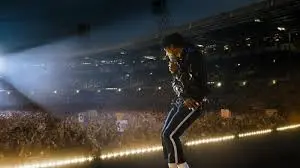
Verified fact: Michael follows Michael Jackson’s rise from the Jackson 5 through to global superstardom, with Jaafar Jackson portraying his uncle and using the singer’s original vocals in the musical numbers. The film is financially backed by the late superstar’s estate, and its cast includes Colman Domingo as Joe Jackson, Nia Long as Katherine Jackson, and Miles Teller as John Branca.
Verified fact: The central criticism is not that the film lacks familiar milestones. It is that it leans heavily on them. Reviewers have described it as a polished but hollow sequence of greatest-hits scenes, with one critic saying it “recreates, in mechanical style, the most famous visuals” of Jackson’s career. Another called it “rammed with every music-movie cliche” and compared it to “a 127-minute trailer montage. ”
Analysis: That is the contradiction at the heart of the michael jackson biopic. It presents itself as a definitive life story while remaining committed to the safest possible version of that story. The result is not just a selective portrait; it is a film that appears designed to preserve the icon while avoiding the cost of explaining the person.
Why is the controversy so central to the criticism?
Verified fact: Reviewers say the film does not address the sexual abuse allegations against Jackson. One review noted that a historic non-disclosure agreement led to some footage referencing those allegations being removed. Another described the finished film as a “whitewash, ” while a separate review called it “ghoulish” and “soulless. ”
Verified fact: The strongest responses came from critics who argued the film confuses tribute with omission. Peter Bradshaw, in a two-star review, said the movie “can’t quite bring itself” to show Jackson as an abuse victim, brutalised by his father and robbed of his childhood. Clarisse Loughrey, awarding one star, argued that the line between “cinema” and “merchandise” had nearly disappeared.
Analysis: These reactions matter because the film’s choices are not incidental. When a biopic removes the most contested material, it does more than simplify; it changes the moral frame of the entire story. In that sense, the michael jackson biopic is being criticised for treating omission as protection, when audiences increasingly read it as avoidance.
Who benefits from a safer version of the story?
Verified fact: The film is backed by Jackson’s estate and uses his original vocals, which dominate the musical sequences. The first screening described in Liffey Valley included a viewer in a “Bad”-era leather jacket and another holding an expensive themed cup, underscoring the audience’s attachment to Jackson’s image and legacy.
Verified fact: Jaafar Jackson’s performance was generally praised. Reviewers said he looked like Jackson, danced like him, and moved like him. But they also said imitation was not the same as insight. One review noted that he “never quite feels like him. ”
Analysis: The beneficiaries of a cleaner narrative are easy to identify: the estate, the studio machinery around a bankable music brand, and a movie format that has become a reliable box-office formula over the past decade. The risk, however, is that the audience is left with a product that can sell the image but not examine the legacy. That is a narrow transaction for a figure whose life remains one of popular culture’s most disputed subjects.
What does the critical response reveal about the biopic genre?
Verified fact: Several reviewers placed Michael inside a broader wave of music biopics built around familiar success stories. The film follows a well-worn template: the first hearing of genius, the rise montage, the confrontation with authority, and the parade of iconic moments, including the making of Thriller and the first moonwalk at Motown’s 25th anniversary.
Verified fact: Kevin Maher gave the film one star and said it would be remembered as a “watershed moment” for the genre, but “not in a good way. ” He called it a film in which the subject becomes “completely untethered from reality, ” even while conceding that the music scenes are “quite brilliant and thrilling. ”
Analysis: That split verdict may be the most revealing assessment of all. The film seems strongest when it is staging performance and weakest when it is asked to interpret the man behind it. For a biopic, that is not a minor flaw; it is the central job description. The criticism suggests that the genre’s commercial logic now risks crowding out its journalistic responsibility to illuminate, not merely recreate.
Accountability: If the aim of a film about Jackson is to preserve a legacy, it must still be transparent about what it excludes. The debate around the michael jackson biopic shows that audiences and critics are no longer satisfied with reverent imitation alone. They want a fuller accounting, a clearer line between tribute and history, and a serious answer to the question the film keeps sidestepping: what does it mean to tell the story of a life by leaving its hardest truths off screen?