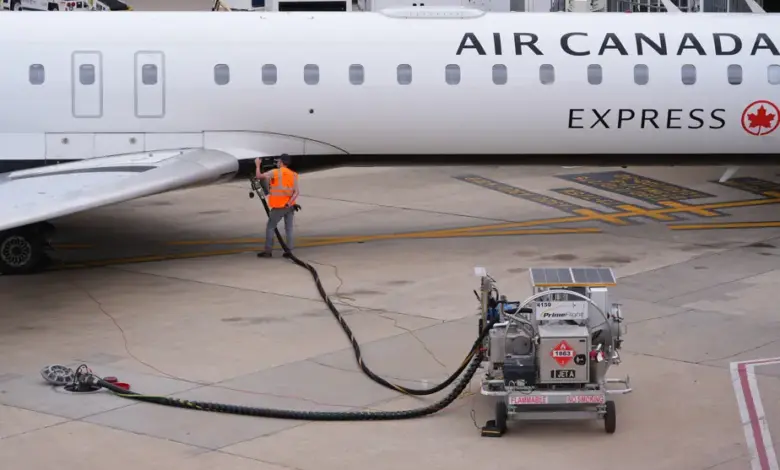
WestJet’s latest move shows how quickly kérosène has become a pressure point for Canadian airlines. The Calgary-based carrier says it has not canceled any routes yet, but it has already trimmed its flying as fuel costs surge in the wake of the war in Iran. The decision is small in percentage terms, but it is revealing: airlines are no longer waiting for a full-scale crisis before adjusting schedules. They are cutting first, then reassessing what summer demand can still support.
Capacity cuts before route cancellations
WestJet says it reduced its capacity by about 1% in April, 3% in May and nearly 6% in June. It has not removed any links so far, but it is reviewing its summer schedule for possible further reductions. In the meantime, the airline has consolidated flights on some routes and shortened the seasonal service period to several destinations. That is a careful response, but it also signals a broader fragility: when kérosène doubles in price, even a modest schedule can become difficult to protect.
The company’s position reflects a narrow operating reality. WestJet is not describing a collapse in demand. Instead, it is describing a cost shock severe enough to make existing planning less workable. The airline is trying to preserve connectivity while adapting to a fuel market that has moved faster than fare structures can absorb. The fact that no route has been dropped yet does not mean the pressure is gone; it means management is still looking for room to adjust before deeper cuts become unavoidable.
Why the fuel spike matters now
The background is stark. The war in Iran has pushed up oil prices and sent kérosène even higher, with the fuel remaining at roughly double its prewar level despite a fragile ceasefire. The disruption is tied to the closure of the Strait of Hormuz, a chokepoint that has helped drive massive volatility in the broader energy market. For airlines, that means one of the industry’s biggest expenses is now more unpredictable and more expensive than it was only weeks ago.
Air Canada has already taken a more direct step. It said last week it would suspend six routes because the fuel costs make them unprofitable. In a separate adjustment, the carrier said four daily flights to New York’s John F. Kennedy airport — one from Montreal and three from Toronto Pearson — will stop being offered from June 1 until October 25. Christophe Hennebelle, a spokesperson for Air Canada, said that some less profitable routes and flights are no longer economically viable because the price of kérosène has doubled since the start of the conflict with Iran.
What this means for travelers and the market
For passengers, the immediate impact is not only fewer choices. It is also a more expensive travel system that may increasingly hide costs inside schedules, surcharges and route changes. Air Canada has said affected customers will be offered other travel options, while maintaining service to other airports in the New York area, including LaGuardia and Newark. But the broader trend is difficult to miss: airlines are using every available lever to protect margins, and that often shows up first in the least profitable flights.
This is where the meaning of kérosène goes beyond the runway. The fuel shock is shaping travel decisions, but it also points to a wider strain across the aviation sector. As more carriers reduce service or suspend routes, the market may become less flexible just as peak travel demand approaches. WestJet’s decision to preserve routes while reducing capacity suggests a measured approach, yet it also shows how close airlines are to the threshold where temporary adjustments become structural changes.
Expert signals and regional ripple effects
No outside forecast is needed to understand the pattern: the numbers already tell the story. WestJet’s gradual cuts from April through June, Air Canada’s suspensions, and the doubling of kérosène all point in the same direction. The effect is likely to ripple beyond aircraft operators. When airlines trim service, travelers face fewer options, and the rest of the travel chain — airports, seasonal destinations and connecting routes — feels the pressure too. The key question is whether fuel prices stabilize soon enough to prevent a wider reduction in summer capacity.
The regional consequence is especially important for Canada, where summer travel depends heavily on dense route networks and seasonal scheduling. If the current fuel environment persists, airlines may continue to prioritize the most resilient routes and pull back from the weaker ones. WestJet has not crossed that line yet. But the fact that it is already reducing capacity and reviewing its summer program suggests the industry is preparing for a more expensive season than it had planned. In that sense, kérosène is no longer just a cost item; it is becoming a filter for which flights survive and which do not.
The next few weeks will show whether these are temporary adjustments or the beginning of a deeper reset, and that leaves one question hanging over the market: how much more can airlines trim before travelers feel the full weight of kérosène?