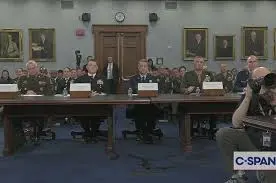
The national guard of the united states is being asked to do more with less clarity: lead domestic responses, support global missions and still preserve training readiness while budget decisions move a key equipment account into the president’s request for the first time. That is the central tension emerging from testimony on the Pentagon’s Fiscal Year 2027 budget request.
What is being hidden behind the budget language?
Verified fact: Guard and Reserve leaders warned lawmakers that readiness is being strained by funding uncertainty, aging equipment and rising mission demands. Army Gen. Steve Nordhaus told the panel, “We represent 20% of the joint force, yet we operate on less than 4% of the department’s budget. ” That imbalance, paired with a broader request structure that now places the National Guard and Reserve Equipment Account inside the president’s budget request, is drawing scrutiny from lawmakers who said they lack supporting documents to fully understand the change.
Informed analysis: The fight is not just about dollars. It is about whether the force can keep its operational tempo without eroding the training base that makes that tempo sustainable. If equipment visibility drops, the risk is that shortfalls become harder to identify early, and that readiness problems appear only after units are already under pressure.
Why is the national guard of the united states under such pressure now?
Verified fact: Testimony on April 19, 2026, centered on a force carrying simultaneous domestic and overseas responsibilities. Nordhaus said the Guard had logged more than 2. 4 million hours of direct support to American citizens in response to domestic crises, while also remaining engaged in worldwide operations. He cited participation in missions tied to Iran, counter-narco-terrorism in the Western Hemisphere and other global requirements, with about 42, 000 Guardsmen currently engaged in homeland and worldwide support.
He also said the Guard’s counterdrug work removed $15 billion in illicit narcotics from American communities in 2025. Congressman Ken Calvert, chair of the House Appropriations defense subcommittee, praised those efforts during the hearing.
Informed analysis: The force is being measured not only by what it can deploy, but by what it can absorb. More missions mean more wear on equipment, more demand on personnel and less margin for error when maintenance, facilities or medical readiness fall behind.
Who benefits from the current structure, and who is carrying the cost?
Verified fact: Lawmakers raised specific concerns that domestic missions in Washington, D. C., and along the southern border compete with limited training time and resources. Rep. Betty McCollum, D-MN, said those demands may not prepare units for large-scale combat operations and questioned what training or modernization could be delayed. She also warned that shifting the equipment account into the broader Pentagon spending plan could weaken Congress’s ability to target urgent shortfalls.
Lt. Gen. John Healy, chief of the Air Force Reserve, described a separate strain in the Air Force Reserve, saying 77% of the fleet is over 39 years old and that a $1. 5 billion maintenance backlog is limiting operations. Army Reserve Chief Lt. Gen. Robert Harter said continuing resolutions and the threat of shutdowns are especially damaging for part-time troops, adding that missed training days are nearly impossible to recover.
Informed analysis: The beneficiaries of a larger mission set are obvious: the federal government gets a force that can answer multiple crises at once. The cost is borne inside the formation, where older aircraft, delayed maintenance and unstable funding can quietly hollow out readiness even when headline mission numbers look strong.
What does the hearing reveal about the next budget fight?
Verified fact: Nordhaus said the Guard must modernize alongside the active component to remain a credible warfighting partner. He called for investment in flying hours, weapons systems sustainment, facilities maintenance, base operations support and the National Guard and Reserve Equipment Account. He also asked Congress to address a funding gap that arises when Guard forces are called into state active-duty status for domestic emergencies under current policy.
Lawmakers said the new budget treatment of the equipment account lacks detail. That detail gap matters because the account has historically been used to target urgent equipment shortfalls, and the current request offers less visibility into distribution across components.
Accountability conclusion: The hearing showed a force under strain not because it lacks relevance, but because its relevance keeps expanding faster than its support structure. If the national guard of the united states is expected to remain both a domestic response force and a global combat reserve, Congress will need clearer budget documents, more transparent equipment planning and a funding model that matches the mission load already on the table. Without that, the warning from this hearing is simple: readiness will remain strained even when the missions keep coming.