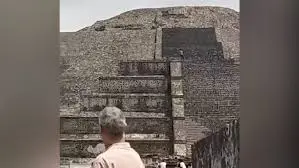
Teotihuacan was supposed to be a controlled historic setting, yet a man opened fire from the Pyramid of the Moon, killing a Canadian tourist and then taking his own life. The result was two dead and at least six injured, including people struck by bullets and others hurt while fleeing down the stairs. That is the verified core of the event: a public monument, hundreds of visitors, and a sudden burst of violence in a place built to preserve history, not absorb it.
What happened at the Pyramid of the Moon?
Verified fact: the attack began past midday in the northern end of the complex, when a man in a checkered shirt moved around the Pyramid of the Moon and started shooting from its height toward the plaza below. The Security Cabinet said he later killed himself. A Canadian woman died in the attack, and four other people were wounded by gunfire, while two more were injured after falling on the 47 steps of the pyramid as they tried to escape.
Verified fact: the site receives around 1. 6 million tourists a year and is described as the second most visited archaeological destination in the country after Chichén Itzá. That scale matters because it shows the setting was not isolated. It was crowded, visible, and active. The violence unfolded in front of the Plaza of the Moon, where tourists were walking as part of the site’s historic route.
How did a weapon reach a monument full of visitors?
Informed analysis: the central question is not only how the shooting happened, but how a person was able to move within a major archaeological site and open fire from one of its best-known structures. The available facts show the police secured a firearm, a knife, and several cartridges at the scene. They also show that an operation was deployed after the attack and that local authorities received calls and inter-institutional coordination reports. What remains unresolved in the public picture is the sequence that allowed the armed man to reach the pyramid, remain there long enough to fire, and cause panic among tourists.
Verified fact: the Secretary of Security of the State of Mexico, Cristobal Castañeda, said there were six injured people in the area, four with gunshot wounds and two with injuries from falling. He also said among the wounded were two Colombians, a Russian, and a Canadian. These details make the event larger than a single nationality or a single victim. The impact spread across visitors from different countries in a matter of minutes.
Who is responding, and what does that response reveal?
Verified fact: Claudia Sheinbaum, President of Mexico, said she instructed security forces to investigate the facts and that staff from the Ministry of the Interior and the Ministry of Culture were heading to the site to provide attention and support to victims. She also expressed solidarity with the affected families and said she was in contact with the Embassy of Canada after the nationality of the fatality was confirmed.
Informed analysis: those responses show a political effort to contain the immediate crisis, but they also underline how serious the breach was. When the head of state orders an investigation and dispatches federal personnel to an archaeological landmark, the incident moves beyond a local police matter. It becomes a test of public security inside a symbolically important national space. The fact that the first official account centered on casualties, coordination, and diplomatic contact suggests authorities understood the event as both a security failure and a reputational shock.
What does this mean for Teotihuacan now?
Verified fact: the attack produced chaos and panic at one of the country’s most visited heritage sites. It also left an armed man dead, a foreign tourist dead, and multiple injured people requiring hospital treatment with support from emergency teams, civil protection, local urgent care services, and the Mexican Red Cross.
Informed analysis: taken together, the facts point to a contradiction at the heart of Teotihuacan: a place designed for preservation and public access became the scene of uncontrolled violence in broad daylight. The immediate issue is not only mourning the dead. It is whether the security model for a site of this size and visibility is adequate for the number of visitors it receives. That question matters because the event was not hidden from view; it occurred in an open tourist area, during the day, amid a crowd.
Accountability question: what controls existed, what failed, and what will be changed before visitors return in confidence? The public deserves a transparent account of how a gunman reached the Pyramid of the Moon, how the first response unfolded, and whether the protections around Teotihuacan match its status as a national landmark. Until those answers are clear, Teotihuacan remains not only a place of heritage, but a case study in exposed risk.