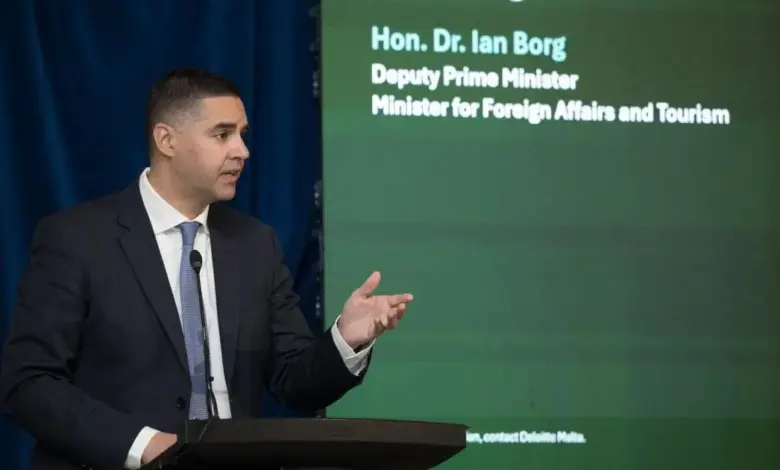
Malta’s tourism story is being recast around one striking figure: 98% of visitors arrive by air. In that context, Foreign Minister and Deputy Prime Minister Ian Borg has argued that the island’s next phase of growth depends less on short-haul markets, which he described as mature, and more on long-haul expansion, including the upcoming direct service between Malta and New York.
What is not being said about Malta’s tourism model?
Verified fact: Borg made his remarks at the fifth edition of the Deloitte Malta Aviation Conference on Friday. He said the future of Malta’s tourism sector rests on long-haul flight connections, and he linked that view to the government’s broader connectivity strategy. He also said the country needs “clarity, consistency, and predictability” so industry leaders can invest with confidence.
Informed analysis: The central issue is not simply whether Malta can add another route. It is whether the country’s tourism model can remain competitive when nearly all arrivals depend on aviation and when the government itself identifies connectivity as the most decisive factor in national competitiveness. That makes route policy more than a transport matter; it becomes a test of economic resilience.
Why does the New York route matter so much?
Verified fact: Borg pointed to the upcoming June launch of direct flights between Malta and New York as an example of the strategy he supports. In a separate address, he said the new service will begin in two months and will operate three times a week from JFK. He also said the government wants more long-haul air routes, particularly from North America and Asia, to attract more resilient, higher-value and more competitive tourism.
Verified fact: The tourism ministry said the Connectivity Strategy, led by the Malta Tourism Authority, prioritises route development, market diversification and year-round accessibility. Borg described Malta as an island state for which aviation is essential and central to the economy.
Informed analysis: The emphasis on New York signals a wider shift in how Malta is trying to position its tourism offer. The goal is not only to increase visitor numbers, but to chase travellers who can support a higher-value model. That matters because long-haul routes are typically treated as a bridge to markets that may spend more and travel differently from shorter-haul visitors.
Who benefits, and who carries the risk?
Verified fact: Borg said Malta needs a “healthy airline mix” and warned policymakers to safeguard the conditions that make investment possible. He also said that the country’s short-haul markets are mature, meaning the next gains must come from expansion farther afield.
Verified fact: On the same day, Prime Minister Robert Abela said Malta would not run out of jet fuel or power plant gas and that the country was prepared to face potential energy challenges beyond August. Borg’s remarks came one day after Fatih Birol, head of the International Energy Agency, warned Europe had “maybe six weeks or so” of jet fuel left in an interview with the. Birol said the continent would soon see flights cancelled as shortages and price increases linked to military action in the Middle East continued to bite.
Verified fact: Wizz Air said it had encountered fuel shortages at three Italian airports, and several Italian airports signalled limitations on jet fuel supplies earlier this month. Europe normally imports half of its jet fuel from Gulf countries.
Informed analysis: These developments expose the vulnerability beneath Malta’s confidence in expanded connectivity. A long-haul strategy can widen opportunity, but it also increases exposure to fuel, route, and supply-chain pressures beyond the island’s control. The winners would be airlines, tourism operators, and a government seeking stronger market diversification. The risk sits with an economy whose growth narrative depends on uninterrupted aviation access.
What do these facts mean together?
Verified fact: Borg framed connectivity as the single most decisive factor in Malta’s national competitiveness. He also said the tourism sector’s future lies in long-haul expansion, while short-haul routes have already matured.
Informed analysis: Taken together, his remarks amount to a policy warning as much as a growth strategy. Malta is not being told merely to add flights; it is being told that its tourism model must be reorganised around route diversity, reliability, and confidence in investment. The direct New York link is the clearest symbol of that shift, but it is not the whole answer.
The deeper question is whether Malta can build a tourism system that is both ambitious and durable. A model built on aviation can expand quickly, but it remains exposed to external shocks. That is why Borg’s call for clarity, consistency, and predictability matters: without those conditions, even the best-connected strategy can lose momentum.
For now, the government is betting that more long-haul routes will strengthen Malta’s tourism sector and broaden its appeal. The public question is whether that bet will be matched by the transparency and stability needed to make it last.