world quantum day is no longer framed only as a celebration of quantum science. It is increasingly acting as a marker of how universities, industry leaders, and public officials are thinking about the next phase of computing, society, and security. In Kingston, Rhode Island, the fifth annual observance at the University of Rhode Island placed that shift in clear view, pairing public discussion with a new student grant program and a look at future lab plans.
What Happens When World Quantum Day becomes a planning signal?
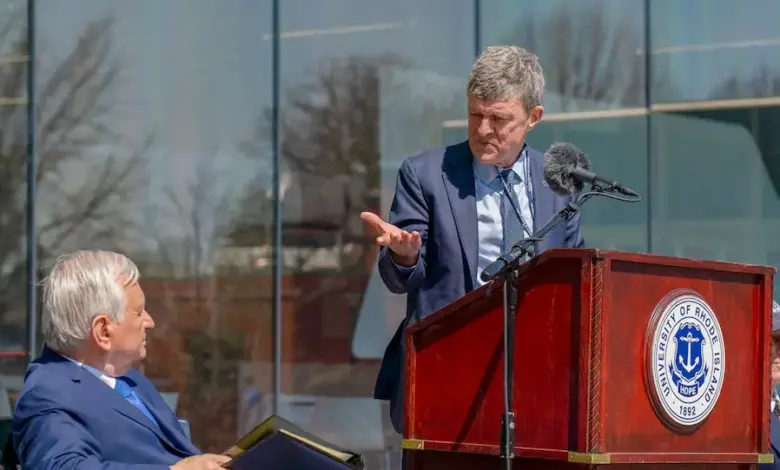
The URI event held on April 10 brought elected officials and technology leaders into the same room to discuss how quantum computing intersects with the humanities and affects society more broadly. The topics were wide-ranging: guardrails for quantum computers, quantum computing and the arts, whether reality is really real, and post-quantum encryption designed to protect vital information from future quantum attacks.
The presence of Rhode Island state Sen. Victoria Gu, Ishann Pakrasi of Amazon Web Services, Christopher Savoie of SiC Systems, Charles Robinson of IBM, and Suhail Zubairy of Texas A& M University underscored a broader shift. World Quantum Day is becoming a platform where research meets public policy and workforce planning, not just a celebration of theory.
What Happens When research, infrastructure, and students are pulled into the same story?
The University of Rhode Island also used the occasion to announce a new quantum-humanities mini-grant program for students. Undergraduate and graduate students will be eligible for financial support for quantum computing research work, with undergraduate awards set at $1, 000 for the student researcher and $250 for the faculty advisor.
The grants are supported by Amazon Web Services and URI’s Institute for AI and Computational Research. That detail matters because it shows how the quantum conversation is expanding beyond labs and into training pipelines. The university’s quantum computing research and workforce development initiative, launched in 2021, already had federal support through a $1 million directed Commerce, Justice and Science earmark secured by U. S. Sen. Jack Reed.
| Signal | What it suggests |
|---|---|
| New student mini-grants | Workforce development is moving earlier in the pipeline. |
| Future laboratory planned for 2028 | Infrastructure is being built with a long horizon. |
| Post-quantum encryption discussion | Security preparation is already part of the agenda. |
| Government-industry-academia participation | The field is being shaped by partnerships, not isolated actors. |
What If the next competitive advantage is preparation?
The clearest trend behind world quantum day is urgency. The event at URI reflected a belief that quantum computing is moving closer to real-world relevance, even if large-scale commercial deployment is still ahead. That urgency also appears in the focus on post-quantum encryption and the future laboratory scheduled to open in 2028 in URI’s Fascitelli Center for Advanced Engineering.
Reed’s remarks framed the issue in national terms, linking quantum computing and information sciences to economic competitiveness, national security, and military readiness. He also pointed to a partnership model among government, industry, and academia. That same pattern appeared in the event itself, where public institutions, technology firms, and university programs were linked through one discussion.
For readers, the key takeaway is not that quantum computing has arrived everywhere at once. It has not. The more important point is that institutions are positioning now for a future in which quantum capability affects research, security, and education at the same time.
What If the path forward remains uneven?
Three scenarios stand out. In the best case, world quantum day becomes a durable anchor for sustained investment, stronger student pipelines, and practical progress on secure systems and research capacity. In the most likely case, progress continues in stages: more campus programs, more public-private partnerships, and gradual movement toward infrastructure that will support future use. In the most challenging case, preparation outpaces deployment in some areas while security and workforce gaps remain unresolved.
For stakeholders, the winners are likely to be universities building research depth, students entering a growing field, and institutions that can coordinate across sectors. Public officials and technology leaders also gain influence by shaping the terms of preparedness early. The likely losers are organizations that wait too long to assess their encryption needs, training gaps, or innovation strategy.
world quantum day is therefore more than a date on the calendar. It is a reminder that the field’s next phase will reward readiness, partnership, and disciplined investment. The reader should understand that the question is no longer whether quantum computing matters, but how quickly institutions can translate attention into capability, security, and talent. world quantum day