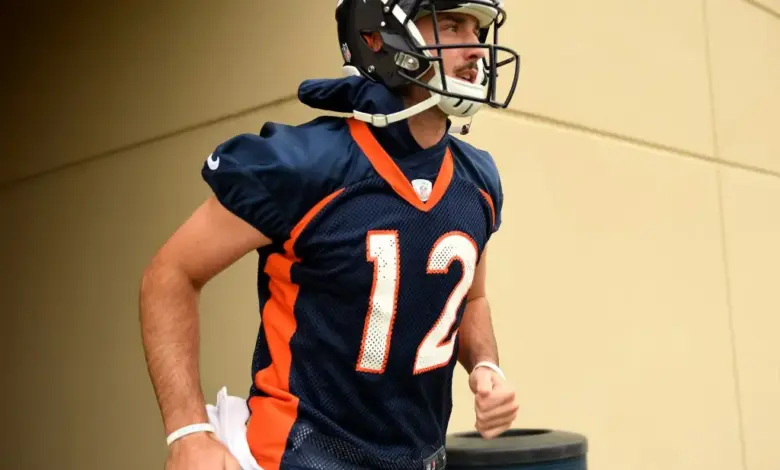
Paxton Lynch entered the spring trying to reclaim something that had slipped away for years: confidence, rhythm, and a football identity that once carried so much expectation in Denver. His return with the Colorado Spartans gave him a brief chance to feel like himself again, but the comeback ended when a knee injury cut the season short in his third game.
What Happens When a Comeback Meets Reality?
The turning point came on a play in Salina, Kansas, when Lynch planted his right leg and took contact from the left side. His knee buckled, and tests later showed a torn ligament injury that ended the attempt before the Spartans could even stage their home debut on April 11. The injury stopped a short run that had already carried emotional weight because of everything that came before it.
For Lynch, the spring was not only about returning to a roster. It was about separating the person from the quarterback who had been judged, moved, and doubted across multiple organizations. He said the point was to play as Paxton Lynch with full confidence, without carrying the burden that had followed him after Denver. That is why the injury mattered beyond the box score: it interrupted a rare stretch in which he felt connected to the game again.
What If the Return Had Lasted Longer?
The Colorado Spartans gave Lynch a path back after a long stretch without a call from any organization. He joined the National Arena League club in 2026 and played two and a half games before the injury. In that limited window, the comeback had a simple purpose: football therapy. He was not chasing former glory so much as testing whether he could still perform with belief intact.
The broader context is difficult to ignore. Lynch was the Broncos’ first-round pick in 2016 and the first draft choice after Super Bowl 50 and Peyton Manning’s retirement. That created a high-stakes start in Denver, where he was expected to carry real weight. Instead, the early promise faded, and his career moved through practice squads, brief opportunities, and long gaps without football. The spring return in arena football was a modest stage, but it represented a chance to reconnect with the game on his own terms.
What Forces Shaped the Short-Lived Revival?
Several forces defined this moment. One was time: Lynch had been away from consistent football for long stretches, and the Spartans offered a narrow opening after no organization had called for a year and a half. Another was identity: he described a split between Paxton Lynch the man and Paxton Lynch the football player, saying that off-field certainty had not always carried onto the field. A third was the structure of arena football itself, where a lower-pressure setting can offer a reset but cannot eliminate the physical risk that comes with the sport.
There was also the human factor. Lynch spoke openly about wanting to play again with confidence, and the injury immediately ended that experiment. Still, he framed the effort as worthwhile. Even if the comeback was short, it gave him a chance to feel authentic in a football setting again, which had been part of the goal from the start.
| Scenario | What it means |
|---|---|
| Best case | Lynch uses the experience as a clean closing point and carries the confidence he found back into life beyond football. |
| Most likely | The injury ends this comeback attempt, and his 2026 arena stint becomes a brief but meaningful final chapter. |
| Most challenging | The injury becomes another hard stop in a career already marked by interruptions, leaving the future uncertain. |
Who Wins, Who Loses?
The clearest winner was the short-term football process itself. Lynch got the chance to compete, reset, and test himself in live action. The Spartans also benefited from the attention that comes with a former first-round quarterback on the field, even if only for a few games.
The biggest loss was the comeback arc itself. Lynch was building toward something more durable, and the injury stopped it before it could settle into a full season. For fans who still remember the expectations attached to his name in Denver, the outcome is another reminder of how fragile football revivals can be. For Lynch, it also reintroduced the same uncertainty that had shadowed earlier chapters of his career.
What Should Readers Take Away From This Paxton Lynch Moment?
The key lesson is not about whether Paxton Lynch can rewrite his career in full, because this injury makes that question harder to answer. It is about how athletes sometimes seek smaller forms of redemption when the larger path is gone. Lynch found a way back onto the field, even briefly, and used it to reconnect with confidence. The injury ended the attempt, but it did not erase what he was trying to do.
That is why this story matters now. It shows how quickly a comeback can arrive, and how quickly it can disappear, even when the intent is honest and the effort is real. For Lynch, the future remains open, but uncertain. For everyone watching, Paxton Lynch is now less a projection than a case study in how football careers can bend, break, and briefly return before the next turn.