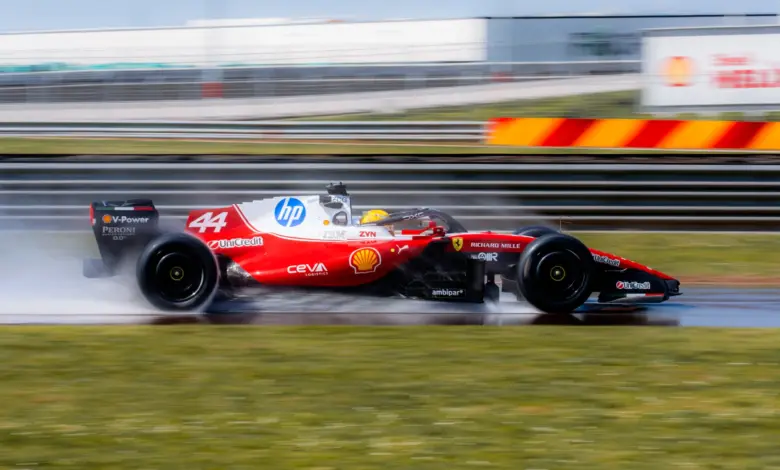
hamilton returned to Ferrari’s Fiorano track this week for a test that was not about lap times alone, but about tyre development. In a month without races, the focus shifted to Pirelli’s wet-weather programme, with Hamilton completing 142 laps on Thursday on full wet and intermediate tyres under artificially watered conditions.
What is not being told about this Hamilton test?
The central question is simple: what did Hamilton actually learn, and what did Ferrari learn from the run? The answer is limited by design. Under the testing terms, Ferrari was not allowed to use the session to evaluate upgrades, different engines, or car settings. Pirelli set the run-plan, and Hamilton was placed in a blind role, providing feedback rather than chasing performance.
Verified fact: the test at Fiorano was dedicated to wet-weather compounds. The surface was made consistently wet through an irrigation system so Pirelli could gather usable data. Informed analysis: that structure matters because it turns the Ferrari car into a controlled instrument for tyre development, not a competitive test of the team’s package.
Why did Pirelli need Ferrari and Hamilton at Fiorano?
Pirelli has been carrying out several tests during April, while no races were held in the month. Ferrari’s session was part of that wider programme. Hamilton worked through full wet tyres and intermediate tyres on a track surface engineered to stay consistent, allowing Pirelli to compare performance across conditions.
On the second day of running, Hamilton completed 461 kilometres, or about 155 laps, with a best time of 1: 00. 470. The two-day total reached 884 kilometres, or 297 laps. Those numbers matter because wet-weather tyre development depends on repeated, controlled running more than raw speed. The aim was to explore the crossover point between full wet and intermediate tyres, a detail that can shape how drivers and teams respond in changeable conditions.
Hamilton’s involvement also followed earlier wet-weather testing activity by Red Bull and Racing Bulls in Japan after the Japanese Grand Prix. Pirelli’s programme has therefore been distributed across teams and circuits, with each session serving a narrow technical purpose rather than a public-facing sporting one.
Who benefits from Hamilton being in a “blind” run?
Pirelli benefits first, because the company needs data from real cars on a wetted track to refine intermediate and full wet compounds. Ferrari benefits in a narrower way, by taking part in a controlled technical exercise at its home circuit. Hamilton benefits only indirectly, through track time and feedback work, but not through a conventional performance test.
That is the key tension in the story: the same session that looks like a return to action is also heavily restricted. Hamilton was driving a 2026-spec Ferrari, yet he was not being used to judge the car itself. The wet-weather programme was the point, and Hamilton’s role was to respond to the plan rather than shape it.
Verified fact: Mercedes and McLaren are preparing for another Pirelli session at the Nurburgring on April 14-15, with both teams due to field regular race drivers. Informed analysis: the continuity of these tests suggests Pirelli is building a broader data set before F1 returns at the Miami Grand Prix, using different teams to cover different technical questions.
What does this say about Ferrari, Hamilton, and the April break?
The wider picture is not dramatic, but it is revealing. April’s race-free window has not meant inactivity; it has simply moved competitive attention into controlled testing. Ferrari’s Fiorano session shows how top teams can be pulled into supplier-led work that sits outside the race weekend but still influences the season’s technical background.
The significance of Hamilton’s return lies in the contradiction it exposes. To the public, it reads like a Ferrari run-out. In practice, it was a tightly managed tyre-development exercise in which Hamilton was instructed to go in blind, then report what he felt. That distinction matters because it shows how much modern Formula 1 depends on hidden technical work that rarely carries the drama of race day but still shapes what follows.
Accountability conclusion: Pirelli, Ferrari, and the other participating teams should be clearer about the purpose and limits of such testing, because the line between driver preparation and supplier development is easy to blur. For now, the evidence shows that Hamilton was back at Fiorano for a controlled wet-weather assignment, and hamilton is best understood here not as a return to racing form, but as part of a larger tyre programme that remains largely out of public view.