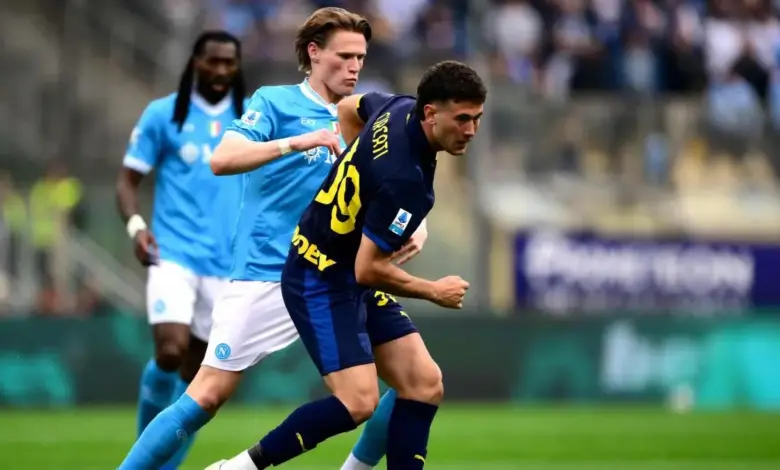
napoli arrived in Parma looking for a fifth straight win and instead found a match that shifted in seconds. At the Tardini, Strefezza scored after just 33 seconds, and the night quickly became a test of patience, pressure, and missed chances.
How did Parma change the match so quickly?
The first minute set the tone. Strefezza’s opening goal forced Napoli into the role of the team chasing the game almost immediately, while Parma dropped into a compact shape and waited for the visitors to break them down. That first punch mattered because it changed the emotional rhythm of the contest. Napoli had the ball, Napoli had the territory, but Parma had the scoreline.
The response was relentless, but not always clean. Hojlund and De Bruyne were both quickly involved, yet their early efforts were blocked in a crowded area. Later, Elmas met a cross from Gutierrez but failed to make proper contact from a promising position. McTominay also tried to force the issue with a rovesciata that was saved by Suzuki. The pattern was clear: napoli kept pushing, but Parma kept bodies in the right places.
Why did Napoli’s pressure only pay off later?
The equalizer finally came in the 60th minute. Lobotka found Hojlund with a direct central pass, Hojlund laid the ball off first time, and McTominay finished from the right side of the area with a strong diagonal strike. It was the kind of move Napoli had been trying to build for much of the match: fast, precise, and decisive.
That goal was important not only for the score, but for what it said about the match. Napoli had dominated long stretches without breaking the wall until one sharp exchange created space. Even then, the visitors could not fully turn the momentum. A later close call came when Alisson tested Suzuki with a strong left-footed effort at the near post, but the goalkeeper held firm. Another late chance saw Keita threaten for Parma, with Milinkovic tipping the shot over the bar.
What does the result mean for Napoli’s wider run?
The draw stopped Napoli after five straight victories. It also left the team with the sense of having done enough to recover, but not enough to finish the job. The match became a reminder that territorial control does not always become a win, especially when an opponent starts with a goal so early and then commits to protecting it.
There was also a broader competitive edge to the result. The match left Conte six points behind Inter, with Inter still set to play Como later in the evening and the possibility of increasing that gap. For Napoli, that context made the result heavier than a simple away draw. It was not only about points dropped in Parma; it was about momentum interrupted at a delicate stage of the season.
Which moments captured the frustration best?
The clearest image came in the second half, when Napoli kept finding half-openings but not the final touch. Politano sent in crosses, De Bruyne tried to set the tempo, and Hojlund stayed busy as a target, yet the final action often broke down in traffic. One chance after another reached the danger zone, then disappeared into Parma’s crowded box.
There were also signs that the home side believed the game could still swing its way. Parma’s own attack became more active late on, and the crowd responded to the effort and to the substitutions that followed. The match did not turn into a collapse or a rescue act. It settled into a draw shaped by one explosive start, one strong reply, and a long stretch of tension in between.
What stays with the Tardini after the final whistle?
It is the contrast. Parma opened with the kind of strike that can tilt a match for an hour, while Napoli spent the rest of the evening trying to turn pressure into precision. McTominay’s equalizer restored balance, but not control. In the end, napoli left with proof that they could respond, and with the harder question of why that response was not enough to complete the comeback.