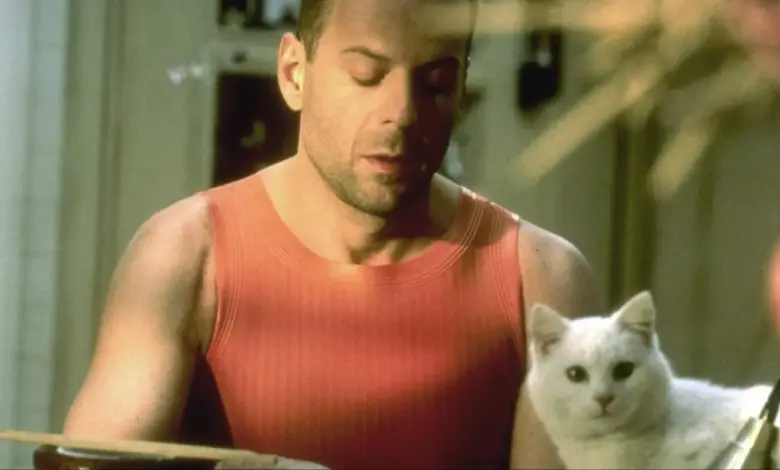
Bruce Willis is back in the streaming spotlight through The Fifth Element, a 1997 sci-fi action film that is now drawing fresh attention nearly three decades later. The film’s new momentum matters because it shows how older catalog titles can regain relevance when audience response and platform visibility align.
What Happens When a Cult Film Finds New Life?
The current moment is a reminder that streaming can rewrite the life cycle of a movie. The Fifth Element is now listed as the No. 8 most-watched movie on Netflix in the United States, while Netflix data also places it as the most-liked movie on the platform as of April 9, 2026. That combination suggests more than a brief curiosity spike: viewers are not just starting the film, they are responding positively to it.
The film’s return is especially notable because its reputation was never simple. It was praised by critics in some quarters and dismissed in others, yet it still grew into a cult classic. That split has not prevented long-term endurance. Instead, it has helped the film remain visible across generations of viewers who are discovering it through streaming rather than theatrical memory.
There is also a clear commercial signal. Released on May 7, 1997, The Fifth Element grossed $263. 9 million against a $90 million budget. It debuted at number one in France and in the United States, became the ninth-highest-grossing film of the year in the US, and held the top box-office spot in France for 16 years until The Intouchables. Those numbers explain why the film still feels durable: it was already a major audience title before it became a streaming title.
What If Audience Taste Matters More Than Critical Consensus?
The film’s current performance suggests that audience preference can outrun older critical labels. On Rotten Tomatoes, The Fifth Element holds a 71% Tomatometer score and an 87% Popcornmeter score, a gap that captures the difference between critical reaction and viewer enthusiasm. On IMDb, it has a 7. 6 rating based on more than 543, 000 ratings, reinforcing the idea that broad audience appeal has outlasted the original debate around the film.
The creative signatures behind the movie also help explain its staying power. Directed by Luc Besson and starring Bruce Willis, Milla Jovovich, Gary Oldman, Ian Holm, and Chris Tucker, the story follows Korben Dallas as he tries to help save the world by recovering four mystical stones. Its blend of action, comedy, and science fiction, along with a distinct visual style, gives it a recognizable identity that streaming audiences can quickly grasp.
That identity is important in a crowded catalog. Viewers often choose films that feel immediate, distinctive, and easy to recommend. A cult title with a singular look and a familiar star can travel quickly inside a platform’s recommendation ecosystem. In that sense, Bruce Willis is part of a broader pattern: legacy stars continue to help anchor older films when those films re-enter the conversation.
What Happens Next for Legacy Sci-Fi on Streaming?
| Scenario | What it means |
|---|---|
| Best case | The Fifth Element stays visible long enough to become a repeat-streamed catalog favorite, with sustained audience approval supporting its ranking. |
| Most likely | The film remains a short-term hit, then settles into periodic rediscovery whenever viewers cycle through sci-fi and action titles. |
| Most challenging | Attention fades quickly if the platform gives way to newer releases, making the current surge a brief spike rather than a lasting trend. |
The most likely outcome is not a permanent breakout, but a durable reminder that catalog films can still perform when the right combination of nostalgia, distinctiveness, and platform placement comes together. The film’s mixed history is not a weakness in this setting; it is part of the draw. People are increasingly willing to revisit titles that were once polarizing if those titles now feel iconic, visually memorable, and easy to sample.
For studios and streamers, the lesson is straightforward: older films are not passive inventory. They can become active assets when audience behavior shifts. For viewers, the result is even simpler. A movie that once lived in the shadow of debate can re-emerge as shared entertainment, especially when modern viewing habits reward discovery over consensus. Bruce Willis closes the loop on a film that continues to prove its staying power, and Bruce Willis may be the name that helps this streaming revival keep moving forward.