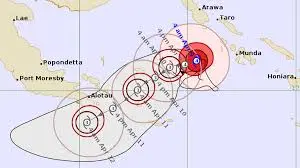
Severe Tropical Cyclone Maila has strengthened to a category five storm over the Solomon Sea, and the immediate question is not whether it will matter to far north queensland, but how much damage will be in place before the system even reaches the coast. Queensland communities could start feeling impacts from the weekend onwards, with heavy rain, flood risk in already saturated catchments, strong winds and hazardous surf.
The central issue is simple: what is not being told by the storm’s intensity alone? The headline number matters, but the bigger story is the combination of timing, track uncertainty and recent storm exposure. Maila is forecast to move toward the Cape York peninsula early next week, with the coast most likely crossed later on Monday, while the same part of the state is still within weeks of Severe Tropical Cyclone Narelle’s landfall.
What is the immediate risk for Far North Queensland?
Verified fact: the Bureau of Meteorology placed Maila over the Solomon Sea on Wednesday and forecast landfall along the Cape York peninsula early next week. BoM senior meteorologist Ilana Cherny said communities in far north queensland could begin seeing effects from the weekend onwards.
Those effects were described in practical terms: heavy rain, flood risk in already-saturated catchments, strong winds and hazardous surf. The warning is important because the region is not starting from a clean slate. Cherny said Maila is likely to follow a path similar to Narelle, with the most probable landfall zone somewhere between the Lockhart River and Cairns. She called that “one of the significant watch points over the next few days. ”
Informed analysis: when a system is forecast to arrive after days of rain risk, the concern is not only the storm’s core but the compounding effect on waterways, roads and low-lying communities. That is why the forecast window matters as much as the wind speed.
Why is Maila being treated as unusually serious?
Verified fact: Maila intensified to a category five storm over the Solomon Sea and recorded a minimum pressure of 924hPa, lower than Narelle’s 930hPa. Cherny said that lower pressure suggests greater storm intensity. Maila is the seventh storm to reach severe tropical cyclone strength in this Australian cyclone season, which runs from November to April.
The scale of that distinction is significant. BoM data since 1980 show that, of the ten tropical cyclones in the Australian region each season, only three or four typically make landfall, and only about five reach severe intensity. In that context, Maila is already exceptional before it reaches Australia. It is also forecast to cross a coastline that has recently been tested by another severe system.
Cherny said the storm would begin to weaken as it moved south-west toward Australia, but she also stressed that there is still a range of possibilities in how fast it moves toward far north queensland. That uncertainty is itself part of the risk.
Who is exposed, and what do officials say about the path?
Verified fact: Cherny said Maila looks likely to move close to, if not over, some of the southernmost islands of Papua New Guinea before reaching the Australian coast. The cyclone’s effects were already being felt on Wednesday in the Solomon Islands, where images circulating on social media showed property damage in remote parts of Western and Choiseul provinces.
Another storm, Severe Tropical Cyclone Vaianu, was expected to make landfall in New Zealand at a similar time. Cherny said Vaianu was a category three system on Wednesday and located about 400km south-west of Nadi in Fiji, adding that it would weaken as it moved out of the tropics.
For Queensland, the relevant issue is Maila’s likely crossing point and timing. Cherny said it is likely to cross the coast early next week, most likely later on Monday, and probably between Lockhart River and Cairns. That forecast puts population centers and remote communities inside the same uncertainty zone, where rainfall totals and local flood response can matter as much as the cyclone’s official category.
What does the recent pattern say about Far North Queensland?
Verified fact: Maila is forecast to hit the far north Queensland coast just weeks after Narelle made landfall on 20 March as a category four system. The context is not just repeated landfall, but repeated severe-weather exposure in a short period of time. Maila is also likely to become the seventh tropical cyclone to make landfall on the Australian mainland this season, and the third to cross the Queensland coast, Cherny said.
Informed analysis: taken together, those details suggest a region facing back-to-back storm pressure rather than a one-off event. The most important public question is whether communities, transport routes and flood-prone catchments can absorb another major hit with only limited recovery time in between. The answer will depend on the storm’s final track, but the warning signs are already clear.
Maila is not just another severe tropical cyclone on a map. It is a test of preparedness, timing and resilience for far north queensland, where the difference between a near miss and a direct crossing may only be measured in a few days of track uncertainty and a few kilometres of landfall shift.