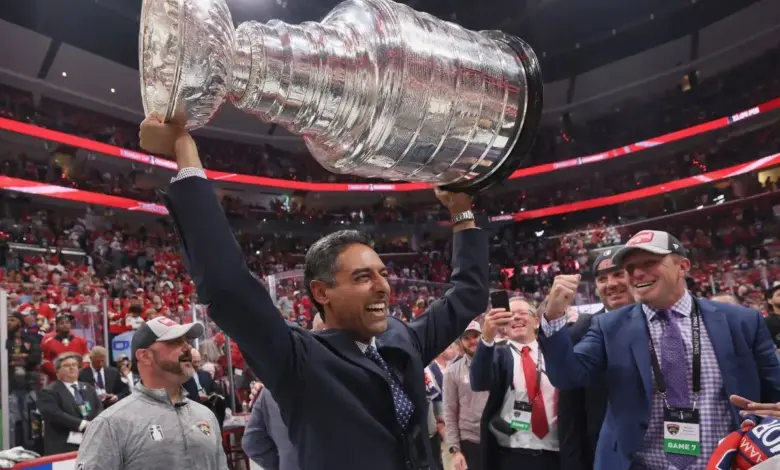
In a league where one decision can reshape a season, sunny mehta has emerged as a name tied to a bigger question in Toronto: what does a contender need most right now? At Scotiabank Arena, the debate is not only about the next general manager, but about how much patience and structure a team needs before it can chase the NHL’s top prize.
Why Sunny Mehta is part of Toronto’s bigger question
Sunny Mehta, 47, is a two-time Stanley Cup champion assistant general manager with the Florida Panthers. His rise has come through work that lives mostly behind the scenes, where player evaluation, transaction planning, and analytical review shape decisions that can alter a roster’s future. For the Maple Leafs, that profile fits a front office conversation already centered on whether the organization is using all of its available resources well enough.
The current opening has pulled attention toward people with a deep analytical bent, and Mehta’s name fits that lane. His experience suggests a style built on patience, data, and the ability to test every move against the larger picture. That matters in Toronto because the club is still trying to bridge the gap between being talented and becoming the kind of team that can sustain a championship run.
What makes Sunny Mehta stand out in Florida’s model
In Florida, Mehta has been linked to a front office that has become one of the league’s reference points for success. The Panthers have made three straight Stanley Cup Finals appearances and won twice, a run that has drawn attention to the way the organization evaluates players and builds its roster. Mehta’s role has been part of that structure, especially as Florida moved from dabbling in numbers to making deeper investigations into player value.
Bill Zito, Florida Panthers general manager, said he and the organization valued Mehta both personally and professionally. Zito described Mehta’s ability to digest large amounts of information, simplify it, and present it clearly to different audiences. That mix of intellect and communication is one reason Mehta has become a name other teams are watching closely.
How the Maple Leafs search frames this moment
The Toronto search has also highlighted the organization’s own self-assessment. MLSE CEO and president Keith Pelley has said the Maple Leafs are not using all their resources to the best of their ability, and the analytics department has become part of that conversation. Mehta’s background makes him a natural fit for a club that has one of the NHL’s largest analytics operations, but wants more from it.
That is where the sunny mehta conversation becomes larger than one job opening. Toronto is not simply looking for a familiar hockey executive. It is weighing whether a more data-centric leader can help align decision-making, roster building, and long-term planning with the scale of the team’s ambitions.
What do Mehta’s background and path tell us?
Mehta’s path has been unusually broad. He grew up a Devils fan in the 1980s, played hockey through high school, studied music at the University of Miami, worked as a guitarist in New Orleans, served as a trader at Peak6 Capital Management at the Chicago Board of Trade, and later earned a master’s degree in data science from City University of New York. He also co-authored two poker books and has long been connected to probability-based thinking.
His route into hockey analytics began early. He published some of the sport’s earliest advanced analytics work and later led the Devils’ first full-time analytics department from 2014 to 2018. He also consulted for the Washington Capitals in the 2019-20 season, worked for the Arizona Coyotes in 2010-11, and contributed to six Major League Baseball teams through a partnership with Zelus.
What happens next for Sunny Mehta and Toronto?
For now, the picture remains measured. The Maple Leafs are evaluating a search that has already drawn names with strong front-office credentials, while Florida continues to be a source of interest around the league. Mehta’s profile suggests a candidate who could help a team think differently, especially if that team is willing to give time to a process built on depth and detail.
In that sense, sunny mehta is more than a buzzworthy name. He represents the kind of executive some teams hope can translate information into structure, and structure into winning. Back at the arena, that leaves Toronto with the same question that opened the search: how much time is a contender willing to give before it finally becomes one?