The new fish market sydney has been framed as both an architectural landmark and an active commercial hub—opened last January and designed by 3XN GXN in collaboration with BVN Architecture and ASPECT Studios—only weeks before an Easter surge forecast to draw more than 60, 000 visitors on Good Friday. That juxtaposition—ambitious urban regeneration meeting immediate operational pressure—reveals competing priorities for design, logistics and the decades-old seafood trade concentrated on the harbour.
Fish Market Sydney: design, scale and public space
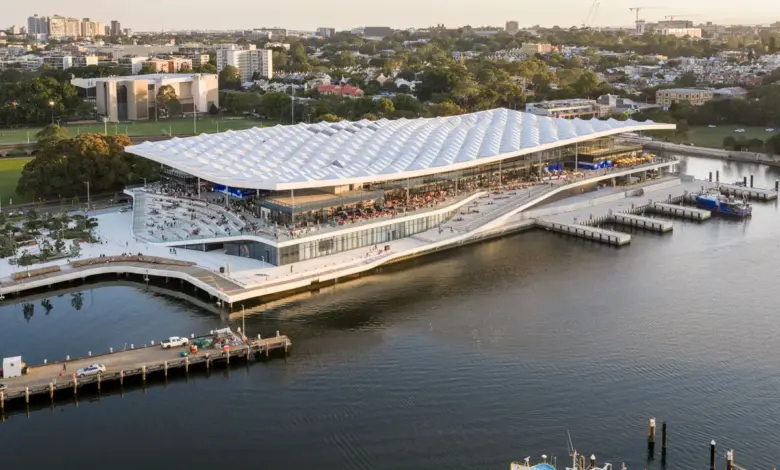
The project reframes a dated 1980s structure that had been one of the city’s top attractions. The development more than doubled the footprint: the original 6, 000 square metres expanded to around 12, 200 square metres, with roughly 6, 000 square metres set aside as public space accessible day and night. The building is arranged on four levels—car park; fishermen and auction areas; fishmongers; and restaurants, cafés, a cookery school and offices—while colonnades and glass walls make the handling of fish visible as a public activity.
Design features are explicit in the scheme and intended to combine spectacle with sustainability: an undulating coffered timber roof channels rainwater into two collectors; roughly 400 pyramid-shaped cassettes on the roof are used to harvest energy on the north side while admitting light and ventilation on the south side; and prefabricated timber beams up to 32 metres long were sourced from North Italy after lifecycle calculations indicated lower environmental impact than domestic road transport. “The fish market in Sydney is an institution, ” state the firm’s partners Audun Opdal and Fred Holt, and the plan keeps the fishing industry “in the heart of Sydney. “
Crowds, trade volumes and operational strain
The operational test arrives quickly. Across the Easter long weekend, operators expected around 650 tonnes of seafood to move through the facility, including about 100 tonnes of prawns and nearly one million oysters, with fishmongers and retail stores opening extended hours from 5: 00 a. m. ET on Friday. Good Friday alone was projected to draw in excess of 60, 000 visitors. Retail programming and family attractions—Easter Bunny visits scheduled 10: 00 a. m. to 12: 00 p. m. ET on Good Friday and 11: 00 a. m. to 2: 00 p. m. ET on Easter Sunday—add to peak footfall.
The market has reported rapid early uptake: more than one million visitors in its first two months of trading. That concentration tests circulation, queuing and supply-chain sequencing in ways the architects anticipated through generous public plazas and visible operations, but that design intent now runs up against short-term logistics: stockpiling, early-morning auctions, extended retail hours and simultaneous restaurant service. Public transport options are noted as proximate, with train, light rail and bus stops nearby and a Transport for NSW trip planner cited as a way to manage arrival flows.
Expert perspectives and what stakeholders say
Audun Opdal and Fred Holt, partners, 3XN GXN studio of Copenhagen, have framed the project as civic infrastructure: “The idea is to provide the city with a functional and scenic platform of benefit to all. Fishermen, workers and customers, but residents and tourists too. ” They emphasize plazas and covered routes designed “as an auditorium for performances and collective activities, ” positioning the market as a nightly-as-well-as-daily public realm.
Paul Scully, Minister for Planning and Public Spaces, said: “The Sydney Fish Market will be buzzing this Easter, set to attract more than 60, 000 on Good Friday and sell more than 650 tonnes of seafood across the long weekend. Fishmongers and retailers are prepared for the crowds with all seafood counters stacked and a number of limited edition Easter treats on offer across retailers and restaurants. The weekend will be made extra special with visits by the Easter Bunny on Good Friday and Easter Sunday. ” The statement frames the short-term surge as both an economic opportunity and a test of operational readiness.
Analysis must separate what is designed from what is operationally tested. The market’s visible processing and enlarged auction and fishmonger zones aim to preserve the industry’s place in the city while inviting large public use; the Easter figures now turn that design hypothesis into an immediate real-world evaluation of circulation, waste management, early-morning logistics and crowd resilience.
Given the facts on record—the doubled footprint, 6, 000 square metres of public space, 400 roof cassettes, prefabricated 32-metre beams, and Easter projections of more than 60, 000 visitors and 650 tonnes of seafood—the site will reveal whether architectural ambition and commercial throughput can operate in concert or whether short-term crowding will force operational adjustments.
Will the fish market sydney emerge from its first high-season weekend as proof that contemporary civic design can absorb intense commercial peaks while keeping an industrial trade visible to the public, or will the rush expose limits that require rapid adaptation?