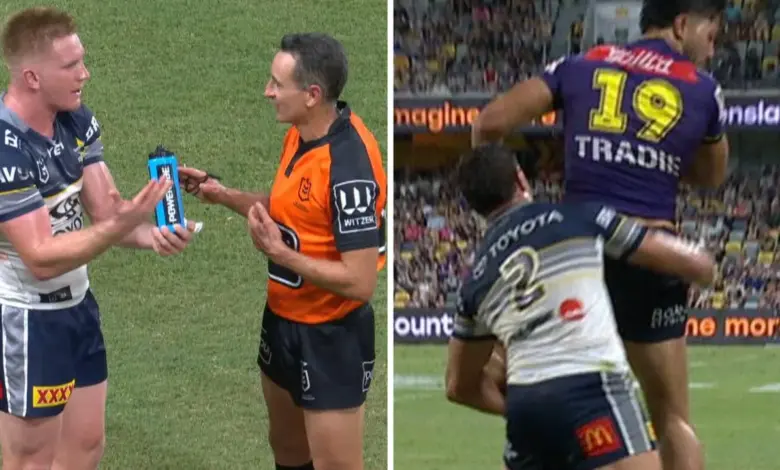
First half, with the Storm leading 16-10, braidon burns was penalised after a desperate attempt to stop Siulagi Tuimalatu-Brown from grounding a Jahrome Hughes kick — a moment that has reignited debate over the NRL’s rule on contact with players in the air.
Why did the Bunker penalize Braidon Burns?
Referee Gerard Sutton asked for a review of the leap, and Bunker official Chris Butler determined Burns completed “a tackling motion while Brown was in the air. ” Butler then ruled out a professional foul or penalty try because the incident occurred within the field of play. Gerard Sutton, referee, told the Cowboys skipper: “It’s going to be a penalty and nothing more than that. But you do make a tackle and motion on him while he’s in the air. “
What exactly occurred on the play that sparked the uproar?
Jahrome Hughes put up a pinpoint kick for winger Siulagi Tuimalatu-Brown, who caught the ball and was coming down on the tryline when Burns reached and touched him while attempting to stop the score. Burns wrapped his arms around the Storm winger as he fell to the turf and then pulled his hands away when he realised what he was doing; the ball was offloaded to Tyran Wishart and play continued when Wishart was brought down by Cowboys defenders. Cowboys skipper Tom Dearden challenged the referee in the moment, saying: “You can’t stand back and let him put the ball down. ” Dearden, Cowboys skipper, added: “You can stand your ground and let him stand and then tackle him. ” The Bunker reviewed whether the mid-air contact denied a scoring opportunity; the ruling was a penalty rather than a sin bin stint or penalty try.
What do the reactions reveal about the rule and its human impact?
The decision drew sharp, vocal criticism from commentators and former players. Greg Alexander, Penrith great and commentator, described it bluntly: “This is the greatest example of why this should not be the rule… that’s how stupid the rule is. ” Andrew Voss, commentator, expressed similar bewilderment: “Wow. That can’t be. He went to do it and then pulled his arms away. ” Their reactions highlight two strains in the debate: one, that by the letter of the law the Bunker call was correct; two, that application of the rule can criminalise instinctive attempts to prevent a try and risk penalising defenders who make split-second choices on the field.
The human dimension was clear in the heated exchange on the sideline. Tom Dearden pressed referee Gerard Sutton on what a defender could reasonably do so close to the line, arguing that a player could not simply “stand back” while an opponent placed the ball down. The Bunker’s Chris Butler acknowledged the tackling motion finding, while refusing to escalate the punishment to a penalty try or send-off because of where the contact occurred on the field.
The controversy does more than settle a single call. Commentators called for re-examination of the rule; critics contend it forces defenders into untenable choices at critical moments. Supporters of the ruling can point to the Bunker’s literal reading of a tackling motion in the air. The clash between literal enforcement and game context — a player trying to stop a near-certain try — is what has driven the outcry.
Back at the sideline where the play began, the replay of that leap will linger. For braidon burns, the penalty was a momentary judgment that unfolded under the microscope of the Bunker and commentators. Whether the rule is changed or clarified will depend on how the game’s custodians weigh the letter of the law against the realities of contesting the ball in the air — and whether they choose to alter an interpretation that many described as “stupid” in its current form.