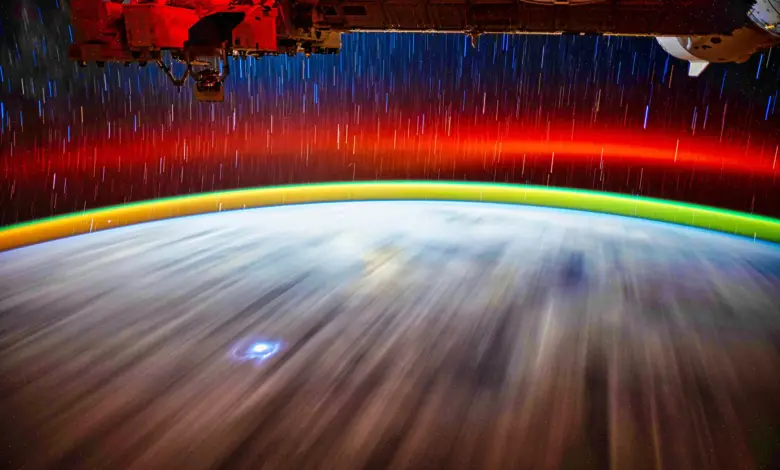
An atmospheric wave was detected roughly 55 miles above Earth when Hurricane Helene hit, NASA instrumentation on the International Space Station shows. The AWE sensor package on the station captured ripple-like patterns in the mesosphere that extended westward from the coast on the day Helene made landfall. The observation links a powerful surface storm to disturbances high in the upper atmosphere that can affect satellite conditions.
Details and immediate findings
NASA recorded a previously unseen pattern about 55 miles above the planet using the Atmospheric Wave Instrument (AWE), installed on the International Space Station in 2023. On September 26, 2024 (ET), AWE’s sensors registered ring-like, ripple patterns in the mesosphere — a layer the context places between about 31 and 55 miles above ground — as Hurricane Helene struck the Florida coast. The signal extended westward from the storm’s impact zone, indicating the disturbance traveled far beyond the immediate storm area.
The AWE package was built to observe faint airglow and subtle infrared fluctuations. Instruments within AWE, including the Advanced Mesospheric Temperature Mapper (AMTM) telescopes, detected brightness and temperature variations consistent with upward-propagating energy from the storm. The observation highlights how energy from violent weather at the surface can compress and propagate into thin upper-air layers, creating what the station’s team identifies as an atmospheric wave.
Atmospheric Wave: reactions from investigators
“Like rings of water spreading from a drop in a pond, circular waves from Helene are seen billowing westward from Florida’s northwest coast, ” said Ludger Scherliess, principal investigator at Utah State University. Vanessa Thomas, NASA Goddard Space Flight Center, added, “These views of gravity waves from Hurricane Helene are among the first publicly released images from AWE, confirming that the instrument has the sensitivity to reveal the impacts hurricanes have on Earth’s upper atmosphere. “
Michael Taylor of NASA described the observation as opening a new dimension in understanding storm impacts on high-altitude air. Engineers and space operators already watch for any change that might shift air density at altitude because even small variations can alter satellite drag and orbital behavior.
Quick context and what’s next
The mesosphere is a high-altitude layer where faint airglow and temperature changes are measurable only with sensitive instruments; AWE and AMTM were designed to pick up those signals. The International Space Station’s vantage point allows capture of patterns that ground-based instruments often miss.
Scientists will continue to analyze the AWE and AMTM datasets to map how frequently powerful storms produce atmospheric waves and how those disturbances evolve. Teams at NASA and collaborating institutions plan follow-up observations to determine whether similar atmospheric wave signatures accompany other major storms, and whether tracking these waves can improve forecasts of upper-atmosphere conditions that matter for satellites and space operations. The next wave of analysis will test how persistent these ripples are and whether an atmospheric wave like the one detected after Helene can be anticipated in future storm events.