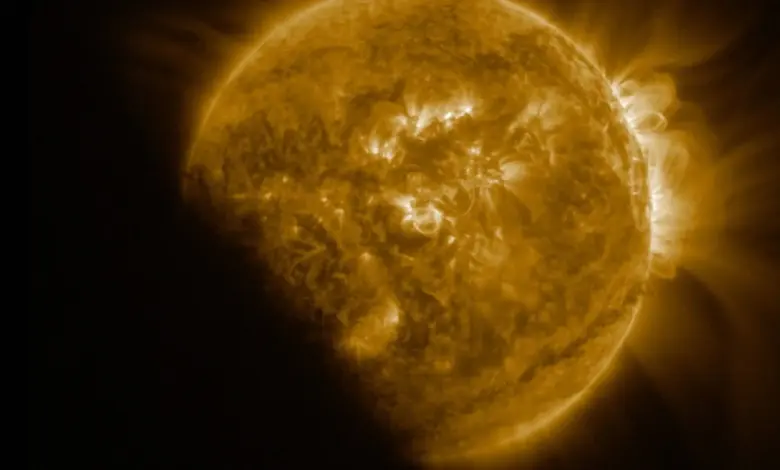
Verified fact: 124, 000 miles beneath the sun’s visible surface — the equivalent of 16 Earth widths — is the confirmed depth of a magnetic dynamo that helps power sunspot cycles and explosive solar storms.
What has been found at the tachocline and how was it measured?
Verified fact: Krishnendu Mandal and Alexander Kosovichev, New Jersey Institute of Technology, present direct evidence that the Sun’s magnetic dynamo is organized at the tachocline, the boundary between the lower convective zone and the inner radiative zone. The team used long-duration measurements of oscillations across the photosphere captured by the Michelson Doppler Imager on the Solar and Heliospheric Observatory (SOHO) and the National Solar Observatory’s Global Oscillation Network Group (GONG). Both instruments measure oscillations that ripple through the photosphere every 45 to 60 seconds, and the research identifies rotating bands of plasma inside the Sun that form a butterfly pattern tied to magnetic organization.
Verified fact: The Sun’s interior structure described in the work includes a nuclear core, an inner radiative zone dominated by gamma-ray photons, and an outer convective zone where convection drives plasma flows — the convective motions that shape oscillation periods and amplitudes measured at the surface.
How do NYU Abu Dhabi’s hidden waves change our view of magnetic activity?
Verified fact: Researchers at New York University Abu Dhabi detected previously undiscovered large-scale, global waves moving deep inside the Sun driven by magnetic fields beneath the surface. Shravan Hanasoge, co-PI at the Centre for Astrophysics and Space Science at NYU Abu Dhabi and lead author of the study published in Nature Astronomy, and colleagues analyzed more than a decade of the Sun’s natural vibrations to reveal these waves. By measuring their motion, the team inferred the strength and structure of magnetic fields well below the photosphere.
Verified fact: The work by NYU Abu Dhabi was carried out with support from the NYU Abu Dhabi Research Institute and frames these waves as a new tool for understanding how the Sun’s magnetic field is formed and evolves over time. The study explicitly links improved knowledge of internal magnetic processes to enhanced ability to predict solar activity that can affect satellites, communications, and power systems on Earth.
What does this combination of findings mean and who must act?
Analysis: Taken together, the New Jersey Institute of Technology result locating a concentrated dynamo at the tachocline and the NYU Abu Dhabi detection of magnetically driven global waves open two complementary windows into the Sun’s hidden engine. The dynamo location constrains where intense magnetic fields are organized; the waves provide a measurable signature that can be used to monitor and quantify those fields over time. This pairing moves the field from indirect inference toward observable diagnostics that can be tracked to anticipate disruptive solar events.
Verified fact: Both teams relied on long-baseline vibration and oscillation records — the same class of measurements that reveal interior plasma flows and magnetic effects by imprinting on surface oscillation periods and amplitudes. Instruments cited in the work include the Michelson Doppler Imager on SOHO and the Global Oscillation Network Group (GONG).
Analysis: For stakeholders — satellite operators, telecommunications providers, and grid managers named in the studies’ implications — these scientific advances imply a pathway to more actionable space-weather forecasting. But turning measurement into operational forecasts will require transparent data sharing, coordinated modeling efforts, and investment in continuous observation programs that preserve the multi-decade records used in the studies.
Who is accountable and what should the public demand?
Analysis: Laboratories and research institutions that manage the observing networks must commit to sustained operations and open access to the oscillation records that made these discoveries possible. Funders should prioritize research that translates the new diagnostics into predictive models. Scientific teams should publish well-documented methods and error bounds so that operators of critical infrastructure can judge forecast confidence.
Verified fact: The studies explicitly link their discoveries to improved space-weather forecasting and to risks for satellites, communications, and energy systems, establishing a clear public-interest rationale for transparency and reform. Public agencies and research institutions named in the work are positioned to lead coordinated responses.
Final assessment: The concurrent confirmation of a deep magnetic dynamo and the detection of hidden global waves change what is observable inside the sun and create an evidence-based case for sustained investment, coordinated oversight, and a rapid push to convert these diagnostics into operational forecasting tools for infrastructure protection.