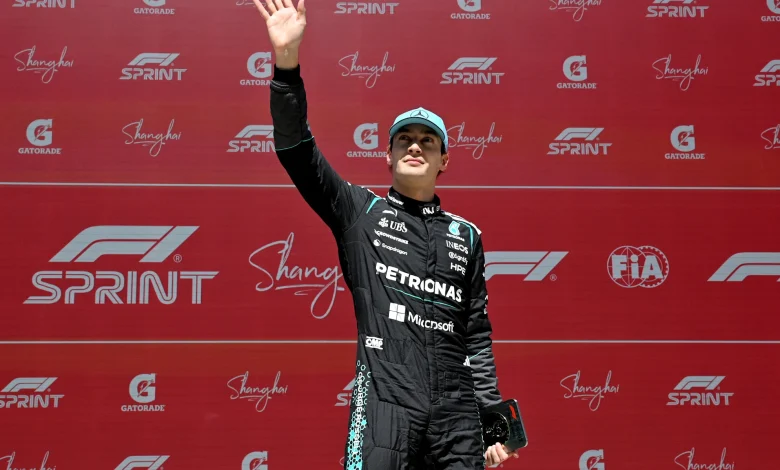
As the sun warmed the Shanghai circuit, George Russell crossed the line to claim the Sprint and the f1 standings were left to reflect a weekend of tight, tactical racing. Russell’s Sprint triumph — ahead of Charles Leclerc and Lewis Hamilton — came after a 19-lap blitz that combined early door-to-door duels, a decisive move into the Turn 14 hairpin, and a late Safety Car that shuffled pit strategies.
What do the F1 Standings show after the China Sprint?
In Shanghai the on-track order delivered a dense middle pack and important momentum swings rather than dramatic points gaps. George Russell continued his 100% winning start to the Formula 1 season in 2026 with the Sprint victory, having started from pole and defended through frantic exchanges with Lewis Hamilton and Charles Leclerc. The Sprint saw lead changes at Turn 9 and Turn 1, until Russell made the decisive move into Turn 14 on Lap 5, pulling clear of Hamilton and Leclerc.
The race was compressed by a late Safety Car called to retrieve Nico Hulkenberg’s stricken Audi, prompting a flurry of pit stops. That sequence left Hamilton forced to stack behind Leclerc in the pits, allowing Russell to hold the advantage to the finish. Behind the podium battle, Lando Norris and Kimi Antonelli traded positions, with Antonelli recovering to take a finishing slot ahead of Norris after serving a 10-second pit penalty for contact with Isack Hadjar on the opening lap.
How did the Sprint unfold on track, and what do team responses look like?
The Sprint began with Russell securing the lead from pole, but Hamilton immediately pressured from his P4 start, demoting Antonelli off the line and overtaking Norris into Turn 1. Hamilton then dove to the inside at Turn 9 to seize the lead, only for Russell to fight back along the back straight and reclaim it into the hairpin. That opening tussle allowed Leclerc — who had begun further back — to work his way into contention and ultimately finish just 0. 6 seconds behind Russell after the late pit stops.
Race recovery and reliability became defining themes. Oscar Piastri finished behind the leading quartet, overtaken late by Antonelli, while Racing Bulls’ Liam Lawson and Haas’ Ollie Bearman claimed the final points by staying out during the late caution. Max Verstappen and Esteban Ocon completed a top-10 that was followed by Pierre Gasly, Carlos Sainz, Gabriel Bortoleto and Franco Colapinto. Isack Hadjar came home P15 ahead of Alex Albon and the Aston Martins of Fernando Alonso and Lance Stroll; Sergio Perez was the final classified Cadillac runner. Nico Hulkenberg, Valtteri Bottas and Arvid Lindblad failed to finish, with Bottas losing power and Lindblad suffering an early-spin retirement.
Voices from the paddock echoed the mixed emotions of a Sprint weekend. Nico Hulkenberg (Audi), who completed his first Grand Prix in his new team, was happy to ‘learn’ from the experience, reflecting the steep adjustment drivers face with new equipment. Sergio Perez (Cadillac) offered his ‘full apologies’ to his teammate after contact in China, a reminder that consequence management off-track is as urgent as on-track recovery. For Mercedes, Russell’s result underlined racecraft and defensive timing; for rivals, it highlighted where late-race pit sequencing and track position still decide outcomes.
The Shanghai Sprint ended as it began — in a swirl of close racing and strategic permutations. Returning to the image of Russell crossing the line, the scene now carries a new weight: his win preserved a perfect Sprint record at the start of the season and left teams recalibrating both setups and strategies. As the paddock turns its focus to the next weekend, teams will be parsing telemetry and pit timing, mindful that a single Safety Car or a stacked pit stop can quickly reshape the f1 standings.