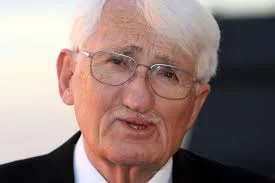
jürgen habermas has died at the age of 96, his publisher Suhrkamp Verlag said; he died on Saturday in Starnberg, near Munich and is survived by two of his three children. The announcement closes a seven-decade public career that made him a central figure in debates over democracy, social theory and the rule of law.
Why this moment marks an inflection point
Habermas’s death arrives at a moment when his core concern—how public opinion forms and sustains democratic life—remains hotly contested. Over the course of his career he argued that the formation of public opinion is vital for democracies to survive. That intellectual claim repeatedly intersected with practical politics: his background in the neo-Marxist Frankfurt school, his reputation as a court philosopher of the Social Democratic party, and his interventions across the political spectrum made him a touchstone for debates at national and European levels.
What Jürgen Habermas leaves behind?
His work and public interventions created a body of achievements and controversies that will shape how scholars and citizens approach democracy and communication in the years ahead.
- Theory: Best known for a political consensus-building theory that placed public opinion at the center of democratic survival.
- Intellectual reach: Widely considered one of the most influential philosophers of the 20th century, with influence on discussions of European integration and the formation of the EU.
- Public interventions: Continued to write books and newspaper articles into old age, including a recent work titled Things Needed to Get Better, which refused to accept defeatism and urged confronting contemporary crises.
- Controversies: His later pronouncements drew criticism from younger intellectuals and colleagues in critical theory, including a condemnatory response to his justification in principle of Israel’s actions after the 7 October Hamas attacks and sharp remarks about contemporary political figures.
- Personal history: Born in Düsseldorf and shaped by early childhood surgeries that left a speech impediment, his life story informed his lifelong attention to communication as a social bond.
What should readers expect next?
The immediate aftermath will focus on intellectual appraisal and political reflection. Reactions already underline the unusual breadth of his impact: leaders from across the political spectrum recognised his analytic acuity and contribution to democratic discourse, while younger scholars questioned some of his later positions. His critiques of national leaders and foreign-policy decisions—whether challenging Angela Merkel over the Greek debt crisis response or sharply assessing statements by other contemporary politicians—illustrate how his normative commitments translated into forceful public interventions.
Institutions and scholars will reassess his writings and public interventions, and debates that Habermas helped shape—about consensus, the rule of law, European integration and the role of intellectuals in public life—are likely to intensify rather than fade. His most recent book, Things Needed to Get Better, signalled that he intended to remain engaged in those debates until the end.
jürgen habermas’s death closes the chapter of a singular public intellectual whose argument that public opinion is central to democratic survival will remain a reference point for those wrestling with the fragilities and possibilities of modern democracy.