Emmanuel Macron travelled to chypre announcing a future international mission described as “purely defensive” to “reopen” the Strait of Hormuz and ensure the circulation of oil and gas — even as a significant French naval deployment is already under way in the eastern Mediterranean and beyond.
Chypre: What was announced at Paphos and aboard the carrier?
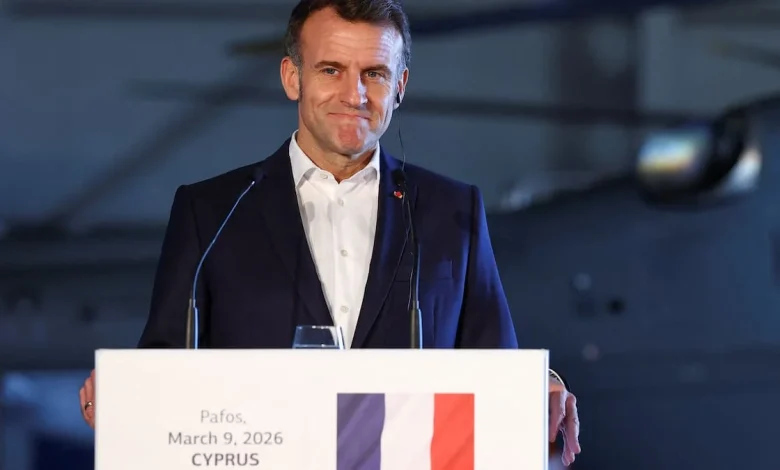
Verified facts: Emmanuel Macron, President of France, stated he is preparing a future international mission he described as “purely defensive” with the objective to “reopen” the Strait of Hormuz and allow the movement of petroleum and natural gas. Macron visited the military airport at Paphos, in the south-west of the island, a site that was struck by a drone shortly after the start of the offensive referenced in the statements. He said the French carrier Charles de Gaulle has been repositioned to the eastern Mediterranean and is now off Crete, and that France is assembling a naval force described by him to include eight frigates and two amphibious helicopter carriers covering areas from the eastern Mediterranean to the Red Sea and the Strait of Hormuz. Macron also said France will contribute two frigates over time to Operation Aspides in the Red Sea, an operation set up in 2024 under Greek command and linked to the European Union.
Analysis (informed): The public framing of a mission as “purely defensive” rests on explicit language used by the French president, yet the scale and geographic reach Macron described — carrier presence, multiple frigates, amphibious carriers and contributions to an EU-named operation in the Red Sea — qualify the deployment as a sustained, multi-theatre posture rather than a short, narrowly tailored escort action.
Who spoke and who is being mobilized?
Verified facts: At Paphos, Macron presented his stance alongside Nikos Christodoulides, President of the Republic of Cyprus, and Kyriakos Mitsotakis, Prime Minister of Greece, who emphasized the defensive character of the actions while asserting protection of European territory. Macron said France, Italy and Spain each sent a frigate to the area. He stated that several European and Asian partners, including India, are being consulted and that participation would be “when circumstances permit. ” Ursula von der Leyen, President of the European Commission, and Antonio Costa, President of the European Council, expressed willingness to adapt and strengthen EU maritime protection missions in response to the situation.
Analysis (informed): The list of named participants and the EU-level readiness to “adapt and strengthen” missions indicate a coalition-building approach. Macron framed the deployments as aimed at protecting nationals and allies; he noted the presence of more than 400, 000 nationals in the region as a justification for the force posture and for potential repatriation operations staged from the carrier group.
What does this mean for regional security and accountability?
Verified facts: Emmanuel Macron said the mission intends to escort container ships and tankers to reopen the Strait of Hormuz once the intensity of the conflict decreases, and that the operation is being prepared with both European and non-European partners. Kyriakos Mitsotakis reiterated the strictly defensive nature of the efforts. Viktor Orbán, Prime Minister of Hungary, announced domestic fuel-price measures in response to oil-price rises connected to the conflict; other international statements were recorded from named leaders in the wider context of the crisis.
Analysis (informed): Taken together, the statements and force movements raise two central governance questions that merit public scrutiny: how will participating governments define and verify the boundary between “defensive” protection of shipping and activities that could be perceived as power projection; and what mechanisms will ensure multinational oversight of rules of engagement, transparency of mandates, and clear timelines for the deployment described by Macron? The combination of carrier-based capabilities and a stated mission to escort commercial shipping suggests long-duration commitments that require concrete, public safeguards.
Accountability call (verified facts and informed recommendation): The facts set out by Emmanuel Macron, Nikos Christodoulides, Kyriakos Mitsotakis, Ursula von der Leyen and Antonio Costa establish the contours of a multinational, maritime response framed as defensive and aimed at keeping trade routes open. Informed analysis points to the need for transparent mandates, parliamentary oversight in the countries contributing forces, and clear criteria for transitioning from escort operations back to routine maritime security. Public debate in affected countries, including on chypre, should be informed by the named commitments above and by regular, verifiable reporting on missions, assets, and engagement rules.