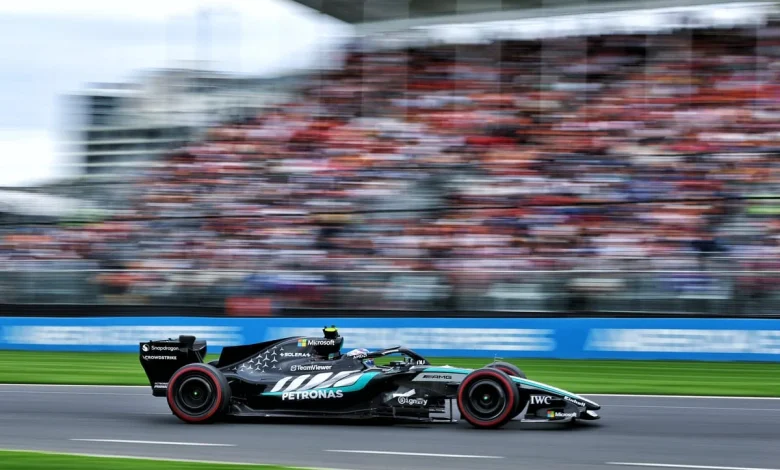
toto wolff figures centrally in discussions after qualifying proved the Mercedes W17 really is the class of the 2026 field. The session delivered blunt metrics: a dominant pole lap with a 0. 785s gap to the nearest non‑Mercedes, deployment advantages on the back straight and strikingly concentrated time losses for rivals across a single sector. That combination reframes Mercedes’ lead as more than raw power — and forces rival teams to rethink battery and aerodynamic trade‑offs.
Deployment edge: Where big Mercedes 2026 advantage really is
Qualifying data shows Mercedes’ superiority manifests most clearly through deployment on the straights rather than sheer cornering minimum speeds. The pole lap was 0. 785s faster than the closest non‑Mercedes, and George Russell’s margin over the lead McLaren‑Mercedes of Oscar Piastri measured 0. 862s. Speeds at the exit of Turn 8 were similar for the fastest cars — 290km/h for Russell and Charles Leclerc, 289km/h for Isack Hadjar and 291km/h for Piastri — yet the Mercedes began gaining time immediately after that point.
Between that shared full‑throttle point and the approach to the next braking zone, Leclerc lost 0. 225s to Russell, Piastri 0. 252s and Hadjar 0. 332s. The divergence continued: in the run through the subsequent sequence the additional losses accumulated to 0. 650s for Leclerc, 0. 722s for Hadjar and 0. 628s for Piastri by the time the cars reached Turn 11. Those losses are concentrated: roughly 32% of the lap corresponds to a disproportionate share of individual cars’ time loss in that sector — about 80% of Leclerc’s deficit, 92% of Hadjar’s and 73% of Piastri’s.
Toto Wolff: Energy management and the chassis question
The pattern points to energy deployment and management as the differentiator, not just peak engine power. Drivers and team principals described a new approach to qualifying this year; Andrea Stella, McLaren team principal, called it “a new language and a new way of thinking, ” highlighting how the format and power restrictions change setup priorities. George Russell highlighted the chassis as well as the engine, saying, “We’ve got a really great engine beneath us. However, we’ve also got a really amazing car beneath us and that probably hasn’t been highlighted enough. “
Oscar Piastri, driver, McLaren‑Mercedes, offered a stark contrast in operating style: “I don’t know what the Mercedes lap looks like, but we were lifting and coasting three times a lap… And in some corners we’ve got effectively 450 horsepower less. ” The implication is that Mercedes’ package lets its drivers lift later and sustain higher peak speeds before shedding energy, so deployment on long straights converts to larger time gains than cornering minimum speeds alone would suggest.
McLaren’s theory on Mercedes’ concerning Australia F1 advantage
McLaren and other rivals are framing the problem two ways: recovering lost deployment on the straights through aerodynamic and gear‑ratio changes, and optimising battery usage so drivers can remain on throttle longer. Lando Norris, driver, McLaren, described the trade‑offs in battery strategy: “The more speed you have on the straight, the sooner you can lift. The sooner you lift, the more power you have and the longer you can keep the throttle on… So the better the car is, the better you can use the battery. “
Red Bull’s debut of its own power unit highlighted different weaknesses; Isack Hadjar’s lower cornering speeds underlined that downforce and grip remain critical. Max Verstappen’s pre‑weekend note that Mercedes should be watched was borne out in qualifying, when Mercedes appeared to marry engine and chassis in a way rivals could not match on one lap. The absence of one top contender from the final shootout and deployment issues for other teams complicated the comparison, but the metric that most isolates Mercedes is how much speed it retains and when it begins to shed that speed.
Experts and engineers will now parse gear ratios, battery deployment windows and aero balance to see where the largest gains are attainable. Mercedes’ advantage is not reducible to a single component: it is a system effect in which chassis stability, energy usage and deployment timing amplify each other across a lap.
Given the data and driver testimony, the central technical question for rivals is clear: can aerodynamic or energy‑strategy changes claw back the concentrated losses that appear in a single sector, or will Mercedes’ integration of chassis and power unit impose a longer‑term advantage?
toto wolff will be central to any public narrative about how Mercedes defends and develops that edge, but the empirical story is embedded in lap traces and sector splits: deployment, not just corner speed, shaped qualifying outcomes. As teams head into development cycles, the task is technical and specific — and the simplest open question remains the most pressing: can competitors alter lap composition as quickly as Mercedes seems to be exploiting the new regulations?