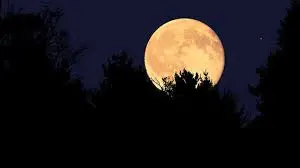
May’s full moon is set to light up the night sky on Friday 1 May, rising as daylight fades and hanging low in the eastern sky before climbing higher toward midnight. For many skywatchers, it is a small but striking seasonal marker — one tied to wildflowers, warmer evenings, and a sky that shifts through the night.
When will the Full Moon appear?
The Flower Moon will rise on Friday evening, then cross the southern sky before setting toward the south-west around dawn. That makes the best viewing window stretch across much of the night, especially for anyone able to catch it soon after sunset. The name Flower Moon comes from Native American seasonal naming traditions and was later popularised through sources such as the Farmer’s Almanac. In May, those older names reflected the burst of wildflowers, warmer weather, and renewed plant growth.
The full moon also fits the season in the UK, where early May often brings bluebells in ancient woodlands, hawthorn blossoms along hedgerows, and longer evenings that feel softer and warmer. This year’s Moon will look slightly different from the bright, oversized versions people sometimes expect. It is a micromoon, meaning it appears a little smaller than usual because it is near the farthest point from Earth in its orbit.
Why is this Full Moon smaller than usual?
The Moon’s monthly path around Earth is not a perfect circle but a slight ellipse, so its distance changes over time. When this month’s full moon becomes full, it will be close to apogee, the point in its orbit farthest from Earth. The difference between apogee and perigee is large in distance terms, but the change is subtle to the naked eye. In photographs, though, the contrast can be easier to notice. The overall effect is a Moon that may appear a touch less bright and a little smaller than average.
That subtlety matters because it shifts the mood of the night. Instead of a dramatic supermoon moment, this one offers a quieter glow — the kind that rewards patience, a clear horizon, and a little time outdoors. Low pressure drifting closer to the UK toward Thursday and Friday could bring showers, especially in western regions, and more cloud may limit a fully open view. Even so, the sky may still clear in patches long enough for a look.
What if you miss the first Full Moon?
If clouds block the view or the timing does not work out, May still offers a second chance. A rare Blue Moon is expected at the tail end of the month — a second full Moon in a single month. That happens once every two to three years, which is why the phrase “once in a Blue Moon” has become so familiar. For observers, it turns May into a month of two separate lunar moments: one tied to the Flower Moon and another defined by rarity.
The appeal is not just astronomical. It is human, too. People notice these moons because they arrive at the edge of ordinary routines — after work, after dinner, after the light begins to fade. A moonrise can turn a normal evening into something worth stepping outside for, even if only for a few minutes.
How should skywatchers approach the night?
For those hoping to see the full moon, the simplest plan is to find a clear view toward the east soon after sunset and then follow it as it rises higher through the night. Cloud cover may come and go, so patience matters. The Moon will remain visible for hours, moving from east to south-east, then across the southern sky before dropping toward the south-west near dawn.
In a month built around flowers and longer days, this Moon is a reminder that small changes can still feel meaningful. It may be slightly smaller than usual, but it still returns with the same quiet certainty — lighting up the night, asking people to look up, and offering one more reason to pause before May moves on.