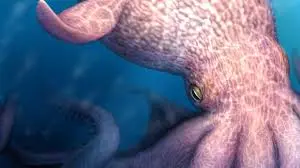
giant octopus research is forcing a fresh look at the ancient oceans. New fossil analysis suggests these animals may have been far larger, more capable, and more central to Cretaceous marine food webs than scientists once assumed.
What If giant octopus was not a supporting player?
For decades, the dominant picture of ancient seas put vertebrates with backbones at the top of the food chain, while octopuses and squid were seen as secondary players. That view is now under pressure. A study led by scientists from Hokkaido University in Japan examined fossil jaws and concluded that some giant octopuses may have reached total lengths of roughly 7 to 19 metres, with body lengths estimated at about 1. 5 to 4. 5 metres.
The key signal is not just size. The fossil jaws show strong wear, including blunting, chipping, and scratching, which suggests repeated use against hard prey. The pattern points to animals that could grab prey with long arms and then crush shells and bones with beak-like jaws. In other words, giant octopus may have been a predator built to handle more than soft-bodied prey.
What Happens When fossil jaws change the food-web story?
The current evidence comes from the hard parts that can survive fossilization: beaks. Soft bodies are rarely preserved, so the research relied on detailed analysis of fossilized jaws and digital imaging. The team re-examined 15 large fossil beaks previously assigned to vampire squids and concluded they belonged to an ancient group of octopus relatives known as Nanaimoteuthis. It also identified 12 additional beaks hidden within Cretaceous rocks, dating from 72 million to 100 million years ago.
One species, Nanaimoteuthis haggarti, stood out because its beak was larger than that of the modern giant squid, which reaches about 12 metres and had long been regarded as the largest known invertebrate. That matters because the new estimate would place this animal among the largest invertebrates ever known to scientists.
| Question | Best-supported answer from the research |
|---|---|
| How long could it be? | About 7 to 19 metres total length |
| What did it eat? | Hard prey such as shells and bones; possibly bony fish, shelled animals, and marine reptiles |
| How was this inferred? | Wear patterns on fossilized beaks and comparison with modern finned octopuses |
| Why is it important? | It challenges the assumption that only vertebrates dominated ancient marine predators |
What If giant octopus had advanced hunting behavior?
Another clue is uneven wear on the jaws from left to right, which suggests the animals may have favored one side when feeding. In living animals, that kind of lateral preference is linked to advanced brain function. Modern octopuses are known for intelligence, problem solving, and complex hunting strategies, and the ancient specimens appear to have used a similar approach: seize prey, then dismantle it with a powerful beak.
Experts who reviewed the work stressed both the scale and the uncertainty. Christian Klug, a palaeontologist at the University of Zurich, said the animals could hold on to prey with their tentacles and suckers. Dr Thomas Clements, a palaeobiologist at the University of Reading, said the size of the beak was remarkable and that he would not have wanted to swim in those ancient oceans. Still, many questions remain, including the exact body shape, fin size, and swimming speed.
What should readers watch next?
The most likely near-term outcome is a broader rethink of who ruled the ancient seas. The research does not prove every detail of diet or movement, and it does not show stomach contents. But it does make a strong case that giant octopus may have been a top-tier predator rather than an evolutionary side note. The best-case reading is that future fossil finds will clarify the animal’s anatomy and feeding habits. The most challenging reading is that even after this study, much of the creature’s life will remain inferred from limited hard evidence.
For now, the main takeaway is clear: ancient oceans may have been more competitive, more varied, and more surprising than previously thought. Readers should expect more revisions as scientists keep testing old assumptions against new fossils. giant octopus