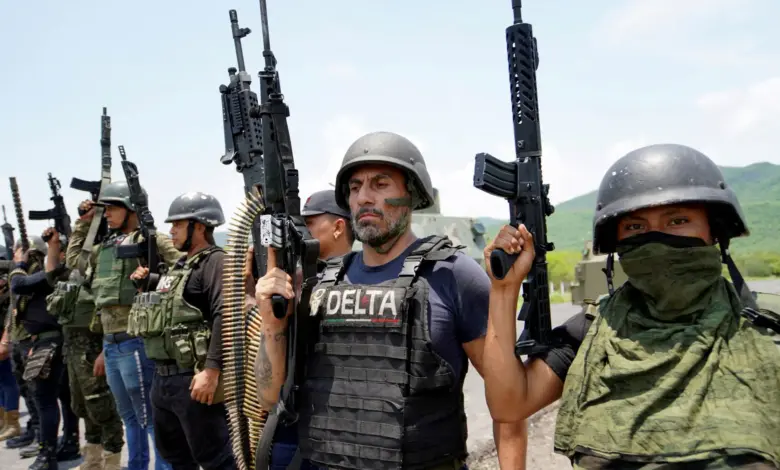
drug cartel politics in Mexico have reached a sharper inflection point as the government faces a harder question: whether hitting leadership actually reduces violence, or simply reshuffles it. In the current cycle, the pressure is not only coming from armed groups on the ground, but also from Washington, where demands for tougher action are colliding with Mexico’s legal and constitutional limits.
What Happens When the Kingpin Strategy Meets a Moving Target?
The latest developments show why this debate matters now. After the arrest of Ismael “El Mayo” Zambada in Texas in July 2024, activists in Sinaloa began tracking a troubling rise in disappearances. By September 9, a power struggle inside the Sinaloa Cartel had turned into a wider wave of murders, femicides, and missing-person reports. In Sinaloa, homicides jumped from 44 in August to 142 in September. The violence continued into 2025, when 1, 657 people were killed, while Sabuesos Guerreras estimates disappearances have reached 5, 800 since July 2024.
That pattern is central to the debate over drug cartel enforcement. Maria Isabel Cruz, whose own son disappeared in 2017, has questioned whether there is truly a strategy when the focus remains on leaders while the lower levels of criminal power stay intact. Bernardo Leon Olea, a former security commissioner in Morelia, Michoacan, argues that removing leaders often fragments cartels, which can trigger more violence as factions fight for control.
What If Pressure From Washington Deepens?
The political backdrop is equally important. President Claudia Sheinbaum has continued with the kingpin strategy, but the context is shaped by pressure from the United States. Donald Trump has repeatedly threatened action if Mexico does not confront cartels more aggressively, has already imposed steep tariffs on Mexican exports, and has hinted at military action on Mexican soil to eradicate criminal networks. That combination gives Mexico less room to slow the tempo of operations.
The result is a more volatile security environment. In Mexico, the argument is not just about arrests; it is about whether the state can avoid repeating a cycle in which cartel leadership is weakened, factions multiply, and civilians absorb the fallout. Leon Olea’s view is blunt: extortion, drugs, crime, and corruption do not end simply because one figure is removed. For communities living inside the violence, the drug cartel problem remains embedded in daily life.
What Happens When CIA Involvement Becomes Part of the Story?
The second major strain is sovereignty. Mexico has launched an investigation after two U. S. officials who died in a vehicle crash following a raid in Chihuahua were reported to be CIA operatives. Sheinbaum said her government was not informed that CIA agents would participate in the raid of a clandestine drug lab, and she stressed that any relationship with the United States on security matters must go through Mexico’s federal government and foreign ministry.
That concern is reinforced by Mexico’s national security rules, which do not allow joint operations without prior federal approval. State officials offered conflicting accounts of whether and how the Americans were involved, while Chihuahua’s attorney general said U. S. “instructors” did not directly take part and arrived only after the raid for training purposes. The issue has widened beyond one operation. It now raises questions about how far cooperation extends, and whether intelligence support is becoming operational involvement.
| Scenario | What it means | Likely effect |
|---|---|---|
| Best case | Coordination stays within legal limits and focused arrests avoid broad fragmentation | Less room for escalation, more room for oversight |
| Most likely | Mexico continues targeted arrests under U. S. pressure while violence remains uneven | Localized gains, persistent instability in affected regions |
| Most challenging | Further opaque cross-border involvement fuels sovereignty disputes and cartel splintering | More conflict, more distrust, greater civilian cost |
Who Gains, Who Pays, and Who Gets Stuck in the Middle?
The current approach creates clear winners and losers. For Washington, visible arrests can be framed as progress against transnational crime. For Mexico’s federal government, continued action can signal resolve under pressure. But civilians in places such as Sinaloa bear the greatest cost when power struggles follow decapitation efforts. Families searching for missing people, local communities facing extortion, and residents living near areas of cartel competition are the ones most exposed to the consequences.
There is also a institutional cost. If foreign agents are seen as moving beyond intelligence-sharing and into operations, the sovereignty debate will intensify. Sheinbaum has been explicit that foreign agents operating in Mexico are not acceptable under the constitution and law. That position matters not only for diplomacy, but for the credibility of any future security framework.
For readers, the key lesson is that the drug cartel fight is no longer just about arrests or raids. It is about whether leadership-focused tactics can contain violence without multiplying it, and whether bilateral cooperation can remain lawful, transparent, and politically sustainable. The next phase will depend less on rhetoric than on whether Mexico can reduce harm without surrendering control of its own security agenda. drug cartel