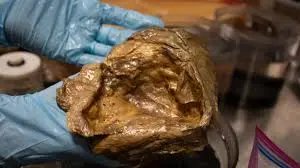
A strange ocean object found miles below the Gulf of Alaska in 2023 has finally been identified, and the answer is more unusual than the speculation that swirled around it. What looked like a golden mound with a hole in it turned out not to be an egg, sponge, or something unknown, but part of a giant sea anemone. The finding matters because it shows how deep-sea exploration can uncover surprises that routine observation cannot solve, even when the object is collected and studied carefully.
What scientists found in the deep
The object was spotted by a remotely operated underwater vehicle more than two miles underwater in the Gulf of Alaska. It was attached to a rock and described as a strange, golden, mound-shaped object with a hole in it. After collection, it was sent to the Smithsonian National Museum of Natural History for study. The first challenge was simple to describe and hard to answer: what exactly was it? In the ocean depths, appearances can be deceptive, and this case became a test of multiple scientific methods rather than a quick identification.
Allen Collins, director of NOAA Fisheries’ National Systematics Laboratory and a zoologist, said he initially expected routine processes to solve it. Instead, the object required morphological, genetic, deep-sea, and bioinformatics expertise. That detail is important because it shows how one unusual find can pull together specialists across disciplines. The golden object was not an animal itself, but a fibrous material covered with stinging cells. Those cells, identified as spirocysts, exist only on cnidarians, the group that includes corals and anemones. That first breakthrough narrowed the field, but did not immediately close the case.
Why the ocean orb took so long to identify
The turning point came when scientists compared the object with a specimen collected in 2021. The cells looked similar, and the team determined the two were the same species. Initial DNA testing on both specimens was inconclusive, which made the mystery deeper rather than shallower. Only whole-genome sequencing provided the needed clarity: the samples were genetically almost identical to Relicanthus daphneae, a kind of cnidarian. That meant the golden orb was once part of the base of a giant sea anemone.
Even then, the identification left one open question. NOAA said the golden object is usually hidden underneath the anemone, but this one seems to have been left behind. Scientists do not know what happened to the top of the anemone. One possibility raised in the explanation was that it may have died or moved to a new home. The unresolved piece is part of what makes the case compelling: the ocean gave up an answer, but not the whole story.
Deep-sea science, public curiosity, and the bigger lesson
The size of the full anemone also helps explain why the object drew attention. Researchers said the pink-colored, cylindrical body can grow to up to three feet across, with tentacles up to six feet long. Its stinging spirocysts are the largest among all known cnidarians. That scale underscores how much of the ocean remains unfamiliar even to scientists who regularly work in deep water. The golden orb was only the visible fragment of a much larger organism, and the isolated base made it look far more mysterious than it actually was.
William Mowitt, acting director of NOAA Ocean Exploration, said deep ocean exploration often produces captivating mysteries like this one. He said advanced techniques such as DNA sequencing allow scientists to solve more of them and better understand how the ocean and its resources can drive economic growth, strengthen national security, and sustain the planet. His remarks frame the finding as more than a curiosity: it is part of a broader case for continued exploration and better biological classification. In that sense, the ocean is not just a place of discovery, but a laboratory for understanding what remains hidden.
What the identification means beyond Alaska
The broader significance reaches beyond one specimen in Alaska. The comparison with a 2021 specimen and the use of whole-genome sequencing show how modern science can link scattered observations across time. That matters for deep-sea research because isolated finds can be hard to interpret on their own. When a single object can only be understood by comparing it with another sample and then verifying the match genetically, the value of preserved specimens becomes clear. It also shows that the ocean still contains biological forms that can look wholly unfamiliar until the evidence is assembled carefully.
For now, the golden orb stands as a reminder that the ocean keeps its most interesting answers partly hidden. Scientists solved one mystery, but the missing top of the anemone and the path that left its base behind remain open questions. What other deep-sea objects are waiting for the right tools, and the right comparison, before they can be understood?