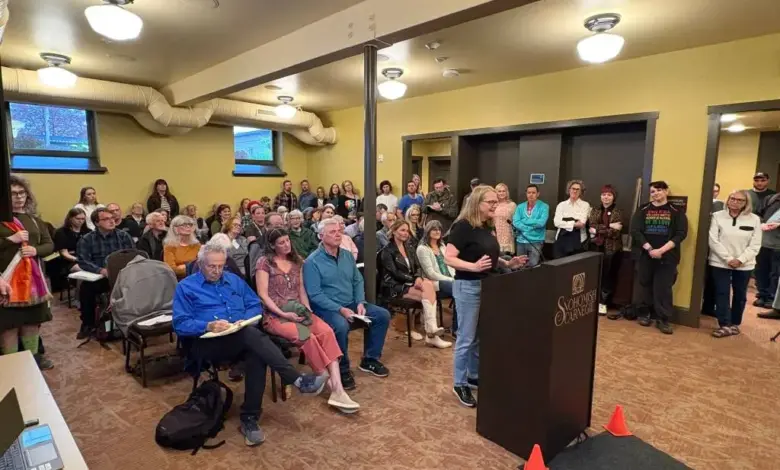
In Snohomish, the city spent another long evening with neighbors facing neighbors as the City Council authorized the mayor to sign the Pride parade contract. The vote came after nearly 90 minutes of public comment Tuesday, closing a night that drew more than 70 people into the chamber and kept the room standing nearly full.
What happened at the council meeting?
The council vote gave Mayor Aaron Hoffman the authority to sign the contract once city staff delivers it, which he said was always the plan. The decision followed earlier council discussion on April 8, but Tuesday’s meeting became the main public forum for people on both sides of the issue.
Supporters spoke about the parade as a civic gathering that reflects the town itself. Peter Messinger, a Snohomish resident, told the council that “exclusivity is the rejection of difference, ” arguing that visible difference in a respectful form is part of what makes a community American. Former city employee Brad Nelson recalled the range of people he has seen at parades over the years, including one older woman in a wheelchair who stayed from the start of the day to the end. His account framed the parade as a day when people linger, watch, and belong.
Opponents also used the public comment period to press their case. Everett resident Pietra Gaebel objected to what she described as confusing imagery for youth. Snohomish resident Carrie Hopper said her religious beliefs shape how she sees the event, while also noting that her views do not erase family ties or personal history. Snohomish resident Erika Minnehan argued the controversy itself was a reason not to approve the contract.
Why did the issue grow so quickly in the city?
The immediate spark was a text poll that reportedly reached thousands of city residents and asked whether they supported “vetoing” the parade. That message added urgency to an already sensitive topic and pushed many supporters to appear at Tuesday’s meeting in person. The pattern was clear: a message on phones became a crowd at City Hall, and the city was left to answer a question that had become larger than one permit.
In practical terms, the dispute was not just about a parade route or a contract. It touched the city’s sense of itself, the meaning of public space, and how a city balances organized celebration with strong disagreement. Organizers said the event draws about 14, 000 people each year, which helps explain why the decision matters beyond the chamber doors. A gathering of that size affects foot traffic, attention, and the emotional temperature of a small city.
For supporters, the parade represents continuity and local life. Deborah Granick described the event as a time when local businesses and residents come together and mark the rhythm of the year. Reverend Drew Frisbie of Snohomish United Methodist Church spoke in support as well, saying Jesus sought out people pushed to the margins of society. Those remarks placed the parade in a wider moral frame without changing the basic fact: the council had to decide whether to allow it to move forward.
How are people responding now?
The council’s authorization does not end the division, but it does settle the immediate question of whether the parade contract can proceed. Mayor Hoffman said he will sign once he receives it from city staff. That step matters because it turns debate into administration, letting the city shift from argument to logistics.
Still, the meeting showed that the city remains split in tone even if the process moved forward. Some speakers called for inclusion and community support. Others asked the council to reject the parade on religious or family-centered grounds. One man raised concern about graffiti he said he found after a previous parade, using it as an argument against holding the event again. The conversation around the parade, then, is not only about one day in the calendar but about what the city is willing to host in public.
For now, the scene that began with a crowded chamber and a long line of speakers ends with a signed contract awaiting the mayor’s pen. In a city where a Pride parade can bring thousands together and still divide the room, the next question is not whether people will keep talking, but how the city will live with that conversation when the parade finally takes shape.
Image alt text: City Pride Contract Approved in Snohomish After a Divided Night of Public Testimony