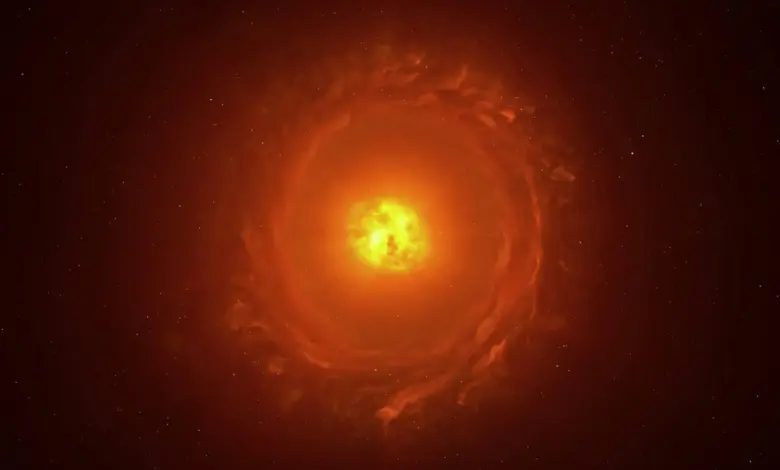
woh g64 has drawn urgent attention after new research suggested the star changed color in 2014 and may now be entering a rare and unstable phase. Scientists say the giant object in the Large Magellanic Cloud could be moving toward the end of its life, possibly through a transition into a yellow hypergiant stage. The latest findings center on long-term monitoring, spectral changes, and a star that continues to behave in ways that are not fully settled.
What Changed in WOH G64
The star, first identified in the 1970s, has long stood out as one of the largest known stars in the universe. It sits in the Large Magellanic Cloud, a dwarf galaxy orbiting the Milky Way, and has been estimated at more than 1, 500 times the radius of the Sun. That size alone made woh g64 a target for decades of monitoring.
Researchers now say the most important shift came in 2014, when the star’s appearance changed in a way that may reflect a major physical transition. The study, led by Gonzalo Muñoz-Sanchez at the National Observatory of Athens and published in Nature Astronomy, argues that the object may have moved from a red supergiant into a rare yellow hypergiant. That change would fit a scenario in which the star is shedding outer layers, shrinking, and heating up as it nears the end of its short life.
In 2024, the star became the first beyond our galaxy ever photographed in detail using the Very Large Telescope Interferometer. That image showed a dusty cocoon around the central star, reinforcing the view that woh g64 is losing mass as it ages.
Why Astronomers Are Watching So Closely
The new work points to several possible explanations. One is that a companion star may be involved, with interaction between the two stars helping eject part of the original supergiant’s surface. The authors say they confirmed the presence of a companion by examining the spectrum of light from woh g64.
Another possibility is that the star is entering a pre-supernova “superwind” phase, when strong internal pulsations drive the loss of material as core fuel is spent quickly. In that reading, the color change is not just cosmetic. It could mark a late-stage shift in the star’s structure and behavior.
Long-term observations add more weight to the concern. Surveys have tracked the star for decades and found a repeating brightness cycle with an unusually long period of 886 days. The same monitoring showed the star dimming around 2011, then rebounding in 2013 and 2014 with a different color and spectrum.
One member of the research team said, “When we first saw the data, we thought we were observing a different star. ” That reaction captures the scale of the change now being discussed around woh g64.
What the Next Months Could Show
There is still no firm timeline for an explosion. The star may be heading toward a core-collapse supernova, but the exact timing remains uncertain. Some research also notes that follow-up spectra have at times suggested red supergiant signatures may have returned, showing that the picture is still unsettled.
That uncertainty is part of what makes woh g64 so important. It is giving astronomers a rare look at how a massive star behaves in a late, unstable stage, and the latest fading seen in 2025 only deepens the interest. If the current changes continue, observers may soon learn whether this is a genuine transition or a more complicated disguise.