John F. Kennedy International Airport Near-Collision Exposes a Safety System Working Only at the Last Second

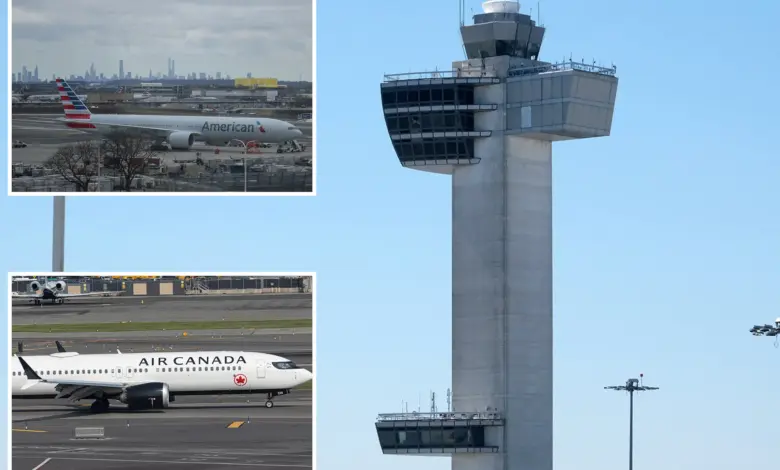
At John F. Kennedy International Airport, two passenger planes came within 350 feet of each other on Monday afternoon, a margin so small that both crews were forced to abort their landings. The episode is a stark reminder that the difference between a routine arrival and a near-disaster can be measured in seconds, not minutes.
What happened in the final moments before landing?
Verified fact: The Federal Aviation Administration said Republic Airways Flight 4464 performed a go-around and deviated from its intended approach path just after 2: 30 p. m. The aircraft, operating for American Airlines, moved into the route of Jazz Aviation Flight 554, which was preparing to land for Air Canada. FlightRadar24 data showed the planes came within 350 feet of each other as they approached the runway.
Verified fact: The tracker also showed the Republic aircraft dropping roughly 600 feet in a matter of seconds while flying over Long Beach, while the Jazz plane climbed nearly 1, 000 feet at the same time. Both planes landed without incident shortly before 3 p. m., after crews responded to onboard warnings and instructions from air traffic controllers.
Analysis: The narrow spacing matters because it shows how quickly an arrival sequence can unravel once one aircraft leaves its intended path. At John F. Kennedy International Airport, the close call was not just a missed landing; it was a near-overlap of two commercial flights in the same airspace, with limited room for error.
Did the warning systems prevent a disaster, or expose a deeper risk?
Verified fact: The FAA said both flight crews properly responded to onboard alerts, which helped avert disaster. Republic Airways said the crew received a resolution advisory from the aircraft’s Traffic Collision Avoidance System, a warning designed to tell pilots to climb or descend to avoid a rapidly approaching threat. Jazz Aviation said its crew received a traffic warning notification and resolution, along with direction from air traffic controllers.
Analysis: The safety systems worked, but only at the final stage. That is the central concern hidden inside the incident at John F. Kennedy International Airport: the aircraft did not simply come close in a generalized sense; they came close enough for automated defenses and urgent pilot action to become the last barrier between order and impact. A system that depends on late intervention may still be effective, but it also reveals how thin the buffer can be when multiple arrivals converge.
Who is accountable when two landings are interrupted?
Verified fact: The FAA said it is investigating the near-catastrophe. The agency has not publicly assigned fault in the information provided. Republic Airways, operating for American Airlines, and Jazz Aviation, flying for Air Canada, both described alert-based responses that led to safe landings.
Analysis: The immediate takeaway is not blame but scrutiny. If the crews followed the required alerts and the planes still came within 350 feet, then the unanswered question is less about individual reaction than about how the approach sequence deteriorated in the first place. The investigation will have to clarify whether the deviation, the approach coordination, or another factor created the risk. Until then, the public only knows that the last defenses held.
What should the public know now?
Verified fact: The incident involved two passenger planes, one operated for American Airlines and the other for Air Canada, both landing at John F. Kennedy International Airport. The event happened Monday afternoon, and both aircraft reached the ground safely.
Analysis: The broader lesson is that safety cannot be judged only by the final outcome. A safe landing after a near-collision is still a near-collision. For travelers, the important fact is that the aviation system corrected the danger before impact. For regulators, the more difficult question is whether the margin was acceptable at all. The answer will matter not just for this case, but for every arrival sequence that depends on perfect timing, clear alerts, and flawless compliance in crowded airspace.
Until the FAA completes its review, the episode at John F. Kennedy International Airport stands as a reminder that aviation safety is often strongest when it is least visible—and most alarming when it is needed at the very edge of failure. The public deserves full transparency about how close the aircraft came, why the approach unraveled, and what must change after John F. Kennedy International Airport.