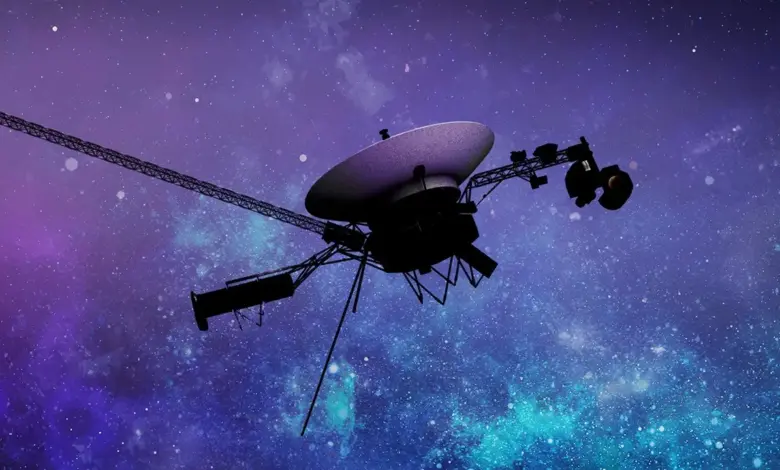
nasa voyager 1 has entered a new phase of survival engineering after mission controllers at NASA’s Jet Propulsion Laboratory in Southern California sent commands on April 17, 2026, to shut down one of its remaining science instruments. The move is not a sign of retreat but of prioritization: with the spacecraft running low on power, the goal is to keep the probe operating long enough to continue its unique work beyond the heliosphere.
What Happens When Power Becomes the Mission?
The instrument taken offline is the Low-energy Charged Particles experiment, or LECP. It had been operating almost without interruption since the spacecraft launched in 1977, measuring low-energy charged particles such as ions, electrons, and cosmic rays. Its shutdown reflects a basic reality of the mission: the spacecraft is powered by a radioisotope thermoelectric generator, and that power output declines over time. Both Voyager probes lose about 4 watts each year, leaving only razor-thin margins after nearly 49 years in space.
The timing matters because engineers saw an unexpected drop in power during a routine roll maneuver on Feb. 27. That brought the spacecraft close to its undervoltage fault protection system, which would have shut down components automatically and forced a risky recovery process. Turning off the LECP manually was the cleaner option.
What If the Remaining Power Is Managed Too Late?
The shutdown was not improvised. Years earlier, the science and engineering teams agreed on the order in which spacecraft systems would be retired while preserving the mission’s most valuable measurements. Of the 10 identical sets of instruments aboard each spacecraft, seven have already been shut off. Voyager 1 now keeps two science instruments active: one that listens to plasma waves and one that measures magnetic fields.
That matters because these instruments are still sending back data from a region of space no other human-made craft has explored. The LECP’s remaining sensor motor will stay powered at 0. 5 watts so it does not seize, preserving a narrow chance of restarting the instrument later if extra power becomes available.
| Mission element | Status | Why it matters |
|---|---|---|
| LECP instrument | Shut off | Conserves power |
| Sensor motor | Still on | Keeps restart option open |
| Two remaining science instruments | Active | Continue interstellar data return |
What If the Next Energy Plan Works?
Engineers are now working on a broader power strategy internally known as the Big Bang. It would replace a group of older, power-hungry components with lower-power alternatives all at once, helping keep the spacecraft’s vital electronics warm enough to function. The plan is scheduled for testing on Voyager 2 in May and June 2026, with Voyager 1 potentially following no sooner than July 2026 if the test succeeds.
The stakes are clear. If the next phase works, the mission could keep at least one science instrument operating on both spacecraft well into the 2030s. If it does not, the team will have less room to maneuver as power continues to decline.
What Happens to nasa voyager 1 From Here?
For nasa voyager 1, the immediate effect of the LECP shutdown is roughly one year of breathing room. Over that period, mission planners can refine the next steps without crossing into automatic fault territory. The broader story is not just about one instrument going dark; it is about how long a decades-old spacecraft can keep working when every watt matters.
The upside is still real. The LECP helped map the frontier beyond the solar system by detecting pressure fronts and regions of changing particle density in interstellar space, and the remaining instruments continue to supply data from a place no other spacecraft has reached. The uncertainty is equally real: even with careful planning, the spacecraft’s aging power system limits how long this can continue.
For readers, the key takeaway is simple. NASA is not trying to preserve everything on voyager 1; it is preserving the most important science for as long as physics allows. The next turning point will come with the Big Bang test, and that will determine whether the mission’s slow, disciplined retreat buys more time or only delays the inevitable. For now, nasa voyager 1 remains active, but only because the mission is being managed with extreme restraint.