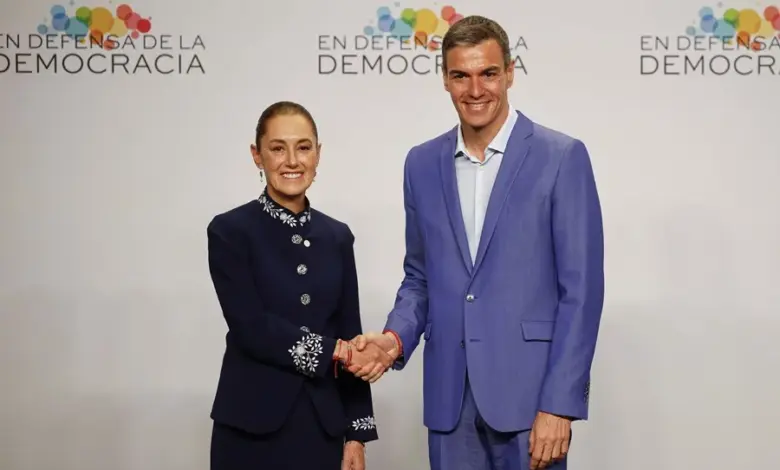
The arrival of claudia sheinbaum pardo in Barcelona carried more than diplomatic protocol: it also carried a message of reset. In her first visit to Europe during this mandate, the Mexican president used the edge of the IV Reunión en Defensa de la Democracia to lower the temperature around relations with Spain. She said there is no diplomatic crisis and framed the encounter as part of a broader effort to keep dialogue open, while also placing democracy, the role of indigenous peoples and future cooperation at the center of the conversation.
Barcelona encounter turns into a political signal
The meeting between Sheinbaum and Spain’s President Pedro Sánchez was the first high-level encounter between the two governments in eight years. That alone made the handshake and brief public appearance in Barcelona politically meaningful. It came after years in which bilateral contact had stalled, and after the 2019 request for an apology over abuses during the conquest that had strained relations. The tone in Barcelona was notably calmer. Sheinbaum stressed that there is no crisis diplomatic and that what matters is recognition of the force of indigenous peoples for Mexico’s national identity.
That message matters because it turns a sensitive historical dispute into a channel for negotiation rather than confrontation. The meeting took place on the margins of a summit built around democratic resilience, making the bilateral exchange part of a larger discussion about institutions, legitimacy and social cohesion. In that setting, claudia sheinbaum pardo used the diplomatic stage not to escalate old grievances, but to keep them within a framework of continued dialogue.
Why the summit mattered beyond ceremony
The Barcelona gathering brought together more than a dozen world leaders and was designed as a space to discuss alternatives to the rise of the far right and the attacks by Donald Trump on the world order. Sheinbaum described democracy as “the power of the people, by the people and for the people, ” borrowing Abraham Lincoln’s phrasing to underline the political theme of the day. That was not a side remark; it linked Mexico’s position to a broader transatlantic debate over democratic legitimacy.
The summit also showed that the meeting was not only about symbolism. Sheinbaum said the two governments would keep working on recognition of indigenous peoples and discussed intensifying cultural exchanges and cooperation in renewable energy. Sánchez later said both sides shared a strong alignment on how to strengthen their very special cultural, economic and social ties. In other words, the Barcelona meeting was presented as a practical step, not just a public thaw.
The 2027 summit changes the strategic map
One of the clearest outcomes was Mexico’s designation as the host of the next Reunión en Defensa de la Democracia in 2027. That decision gives Mexico a central role in the next phase of this progressive forum and places claudia sheinbaum pardo at the center of an international agenda that will likely extend beyond bilateral repair. Pedro Sánchez confirmed the news after welcoming the delegations, which included 15 heads of state and government.
The choice of Mexico suggests that the conversation is moving toward digital governance, disinformation and social trust. The Barcelona sessions emphasized the urgent need to regulate digital environments and warned that algorithms should not reward violent messages. The 2027 summit is expected to continue that line, while also addressing social rights, democratic protection and the impact of technological threats on cohesion. For Mexico, hosting the forum offers visibility; for the bloc around it, it creates a venue to test whether democratic language can produce concrete action.
Expert reading: reconciliation, not rupture
The clearest reading of the day is that both governments are trying to replace a frozen narrative with a managed one. Sheinbaum’s comments indicate that the dispute should be understood as an unresolved historical and symbolic conversation, not as a full diplomatic break. Sánchez’s public language, especially his emphasis on cultural, economic and social ties, points in the same direction. The absence of a confrontation is itself important: it allows each side to preserve political dignity while reopening practical channels.
That is especially relevant because the exchange in Barcelona touched on recognition, not erasure. Sheinbaum said the two governments will keep working on the recognition of indigenous peoples, while also pointing to cultural and renewable-energy cooperation. The balance suggests a strategy of selective rapprochement: careful enough to avoid inflaming domestic sensitivities, but broad enough to produce a workable relationship.
Regional and global stakes for the months ahead
For Latin America, the Barcelona meeting adds weight to a broader progressive effort to defend multilateralism and resist democratic erosion. For Europe, it signals that dialogue with Mexico can move forward even after years of paralysis. For both sides, the challenge is whether this warmer tone can survive beyond a summit setting and translate into sustained institutional contact.
The next test will be whether the promises made in Barcelona lead to concrete follow-up on cultural exchange, renewable energy and the organization of the 2027 summit. If they do, claudia sheinbaum pardo may be remembered not just for calming tensions on arrival, but for turning a symbolic thaw into a durable diplomatic channel. The open question is whether that momentum can outlast the photo opportunity and become a lasting policy line.