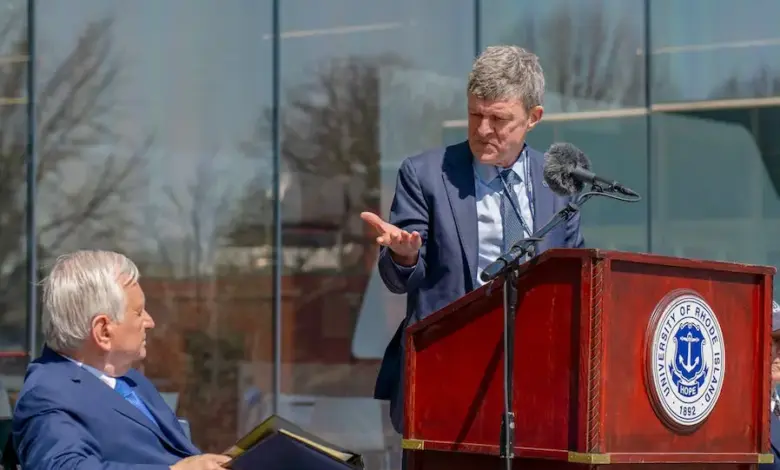
On a spring day in Kingston, Rhode Island, World Quantum Day was not just a celebration of physics. Inside the University of Rhode Island’s Kingston Campus, elected officials, technology leaders, students and members of the public gathered to talk about how quantum computing reaches far beyond the lab and into everyday decisions about security, culture and opportunity.
What happened at URI’s World Quantum Day?
The University of Rhode Island held its fifth annual World Quantum Day event on April 10, part of a global observance that takes place on April 14. The Department of Physics hosted the public program, which centered on the way quantum physics intersects with the humanities and how quantum computing may affect society.
Discussions ranged from post-quantum encryption and societal guardrails to quantum computing in the arts and even the question of whether reality is really real. Guest presenters included Rhode Island state Sen. Victoria Gu, D-Westerly; Ishann Pakrasi of Amazon Web Services; Christopher Savoie, founder of SiC Systems and a URI alum; and Charles Robinson of IBM. Suhail Zubairy, the Munnerlyn/Heep Endowed Chair in Quantum Optics at Texas A&M University, delivered the keynote address.
For URI, the day was also a marker of momentum. U. S. Sen. Jack Reed, D-R. I., toured the future Quantum Computing and Technology Laboratory in the Fascitelli Center for Advanced Engineering before the event. The lab is scheduled to open in 2028 and is planned to include a low-temperature facility for quantum computing, a clean room and an area to review controlled unclassified information.
Why does world quantum day matter beyond science?
The broader message of world quantum day at URI was that the technology is no longer only a research topic. It is being framed as a societal issue that touches economic competitiveness, national security, education and the arts. Reed said the university’s progress could help build state leadership in quantum computers and quantum technology, and he described the strongest path forward as a partnership between government, industry and academia.
That idea was echoed in the structure of the event itself. The audience did not stay in one lane of expertise. Instead, the conversation moved between policy, engineering, public understanding and the humanities. Rhode Island state Sen. Victoria Gu, who chairs the Senate Committee on Artificial Intelligence and Emerging Technologies, brought a legislative perspective to a room that also included researchers, business leaders and students.
Another layer of urgency came from the field’s practical implications. Post-quantum encryption was discussed as a response to the risk that quantum computers could threaten current cybersecurity standards. That makes readiness less abstract and more immediate for institutions that handle sensitive information. The event showed how world quantum day can serve as a bridge between scientific progress and public responsibility.
How are students and researchers being supported?
URI used the occasion to announce a new quantum-humanities mini-grant program for students. Sponsored by Amazon Web Services and URI’s Institute for AI and Computational Research, the program will support undergraduate and graduate research across disciplines, not only in STEM fields. Undergraduates will be eligible for $1, 000, with $250 for faculty advisors, while graduate students can receive $2, 000, with $1, 000 for advisors.
The university’s quantum computing research and workforce development initiative began in 2021 and was supported by a $1 million federal Commerce, Justice and Science earmark secured by Reed. That backing helped establish the foundation for the current effort, which now combines research, workforce development and a broader conversation about the human side of quantum technology. In that sense, world quantum day at URI was not only about ideas. It was also about who gets to participate in the future those ideas are shaping.
What does the URI event suggest about the next phase?
The Kingston gathering suggested that the next phase of quantum development will require more than technical skill. It will need public trust, policy attention and a willingness to connect the science to everyday life. By bringing elected officials, industry leaders and students into the same room, URI turned world quantum day into a test case for how institutions can broaden the conversation without losing sight of the science.
As the crowd moved between discussion of encryption, arts and reality itself, the scene carried a quiet tension: the future is approaching quickly, but the question of how to prepare for it is still being worked out in public. In Kingston, world quantum day ended where it began, with a campus full of people trying to understand a technology that is becoming more visible, more consequential and harder to keep at the edge of the conversation.