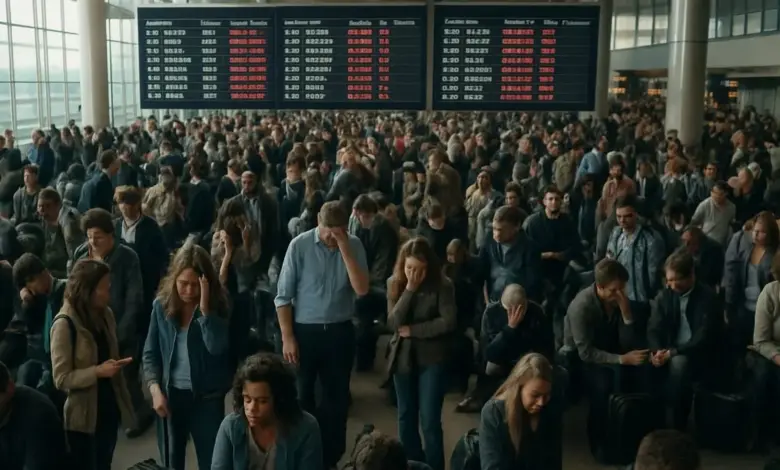
At Frankfurt Airport, the departure boards became a patchwork of red and yellow as travelers watched one update after another replace certainty with delay. The Lufthansa strike on April 10, 2026, landed in the middle of an already strained travel week, and for many passengers it turned a routine connection into a day of rerouting, waiting, and rebooking.
What happened in Germany was not isolated. It came alongside a separate air traffic control walkout in Italy, and together the two actions deepened a wider pattern of disruption across Europe’s aviation system. For airlines, airports, and travelers, the result was not just lost time but a chain reaction that reached far beyond national borders.
Why did the Lufthansa strike hit so hard?
The Lufthansa strike involved cabin crews at Lufthansa and Lufthansa CityLine in a 24-hour walkout. Published coverage said the action led to the cancellation of more than 500 flights from Frankfurt, Munich, and several regional airports. Tens of thousands of passengers were affected during the Easter return travel period, when demand was already high and spare capacity was limited.
The scale of the disruption shows how quickly one work stoppage can spread through a network built on tight timing. When crews are not available, airlines must trim schedules, retime departures, and in some cases consolidate services to keep a smaller program running. That leaves fewer options for passengers already trying to make tight onward connections or return home on time.
How did Italy and Germany amplify the wider aviation strain?
The Lufthansa strike was part of a broader April pattern that also included a national air traffic control walkout in Italy on April 10, 2026. That stoppage lasted four hours in the afternoon and affected flights across Rome, Milan, and other major Italian airports. Airlines there also had to cut schedules, shift departure times, and combine services.
Because Italy controls a large section of southern European airspace and Germany serves as a central hub for long-haul and intra-European traffic, the combined impact spread beyond the two countries. Airport operations data and airline advisories pointed to knock-on disruption in neighboring countries as carriers rerouted aircraft, repositioned crews, and rebooked stranded travelers on alternative services. Some long-haul flights continued through reduced schedules and widebody aircraft substitutions, while short-haul and feeder routes carried much of the cancellation burden.
What are passengers experiencing on the ground?
For travelers, the effects were immediate and practical: cancelled flights, changed departure times, and crowded service desks. The most vulnerable passengers were those on short-haul routes and connections feeding into larger journeys, where one cancelled leg could unravel an entire itinerary. In that sense, the lufthansa strike became more than a labor action; it became a stress test for a system already operating with little room to absorb shocks.
Travelers moving through major airports in Germany and Italy faced a familiar pattern from recent weeks: waiting for updates, adjusting plans, and hoping for alternative seats. The human cost was measured in missed meetings, delayed reunions, extra hotel nights, and the simple fatigue of being stuck between destinations.
What does this mean for Europe’s mid-April travel pattern?
The latest stoppages in Italy and Germany followed earlier strikes in Spain and the United Kingdom, adding to what travel industry analyses describe as a rolling disruption across Europe. In Spain, ongoing and intermittent ground handling strikes have affected Madrid, Barcelona, and Palma de Mallorca, slowing baggage, ramp, and check-in operations. In the UK, warning strikes and targeted walkouts by airport and airline workers have led to longer security queues, isolated cancellations, and tighter turnaround times at London-area airports.
That wider context matters because it shows the lufthansa strike was not a one-off event. It arrived in a month shaped by repeated industrial action, each stoppage reducing the margin for error in an already stretched network. When multiple parts of the system are under pressure at once, even a brief walkout can have effects that last well beyond the strike itself.
What comes next for airports and airlines?
Airlines have been forced to respond by rerouting aircraft, adjusting schedules, and trying to protect the most critical long-haul services. Airports, meanwhile, have had to manage the immediate operational fallout while preparing for more disruption if the broader pattern continues. For passengers, that means checking schedules carefully and expecting changes to remain possible even after a strike window ends.
The scene at Frankfurt, where travelers kept staring at the boards and waiting for a gate number to hold, captured the mood across the region: a network moving, but not smoothly; a day that could still change without much warning. The lufthansa strike showed how fragile that balance can be, and how quickly an ordinary journey can become an uncertain one when Europe’s aviation system is pushed from several directions at once.