Big Mistakes arrives at a moment when post-breakthrough projects are judged less by pedigree than by whether they can justify their own world. Dan Levy’s new series, created with Rachel Sennott, lands with a strong cast, fast-moving mayhem, and a premise built around a family pulled into the criminal underworld. The timing matters because audiences now expect a clear point of view from prestige-comedy hybrids, not just name recognition and energy.
What If the Chaos Is the Point?
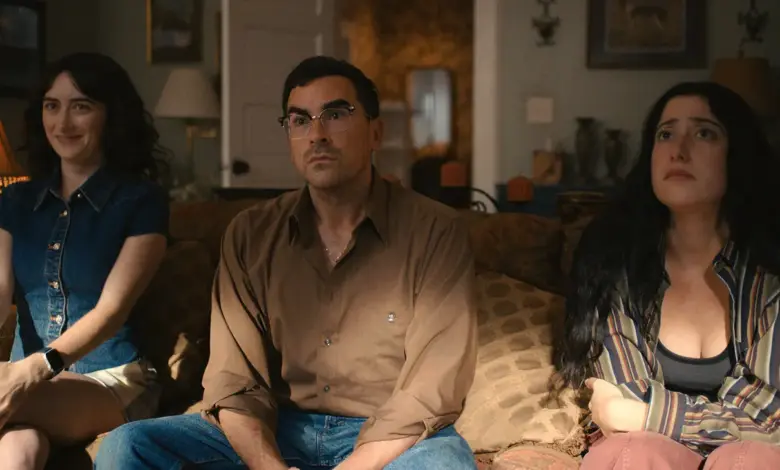
The series centers on Nicky, played by Levy, a pastor who is hiding his boyfriend from both family and flock. His sister Morgan, played by Taylor Ortega, becomes the sharpest comic counterweight, while Laurie Metcalf plays their demanding mother, Linda, who is running for mayor in their New Jersey town after her own mother dies. The family’s troubles quickly escalate when a necklace meant for a dying grandmother turns out to be real, stolen, and valuable enough to bring a criminal gang into the picture.
That setup gives Big Mistakes a built-in engine: anxious, ordinary people colliding with a world they are not equipped to understand. The show leans into that collision rather than realism, using awkward encounters, increasingly tangled obligations, and sudden reversals to keep the story moving. Its tone is broad, and the cast is strong enough to make the material feel alive even when the logic does not always hold together.
What Happens When Logic Takes a Back Seat?
That is the central test for the series. The crime element is less about procedural precision than about pressure, embarrassment, and family dysfunction. The material is clearly designed to be broadly funny and occasionally suspenseful, but it also depends on viewers accepting that many developments are not especially convincing. The necklace plot, the gangland pursuit, and the series’ increasingly strained turns all push the story toward momentum over plausibility.
One useful way to read the show is as a continuation of the dark-comedy tradition that places ordinary people inside intense criminal circumstances. The result, in this case, is not subtle. The writing gives the ensemble room for friction and timing, while the plot supplies the kind of escalating mess that keeps episodes from settling into predictability. For some viewers, that will be the appeal; for others, it will be the limit.
| Scenario | What it looks like | Likely outcome |
|---|---|---|
| Best case | Cast chemistry and surprise drive the show forward | Big Mistakes becomes a sharp, buzzy comedy |
| Most likely | The series stays lively but uneven | Viewers enjoy the performances more than the plotting |
| Most challenging | The implausibility overwhelms the humor | The show feels thin despite its strong cast |
What Happens When a Strong Cast Meets a Thinly Explained Plot?
This is where the future of big mistakes becomes easier to forecast. The cast is a major asset: Levy gives Nicky a nervous, tightly wound energy; Ortega supplies the kind of comic edge that can hold a scene; and Metcalf, as so often, gives the family its center of gravity. The series also benefits from the presence of familiar faces who fit the ensemble’s heightened tone.
Still, a strong cast cannot fully disguise a story that relies on clunky developments or unresolved logic. The show’s crime-world material is presented in vague terms, and the antagonists are more functional than frightening. That means the series’ long-term appeal will likely depend on whether its emotional beats and comic timing can do enough work to compensate for the narrative gaps. If they can, the show may settle into a durable groove. If not, the twists will feel louder than the payoff.
Who Wins, Who Loses?
The clearest winners are the performers. Levy gets another chance to stretch beyond the family-comedy frame that made his earlier work such a breakout, and Ortega has a role that can lift her visibility. Metcalf remains the kind of actor who can make even a structurally shaky story feel worth watching. Rachel Sennott’s creative partnership on the project also strengthens the show’s cultural signal: this is a series trying to combine contemporary family satire with criminal-chaos comedy.
The risk falls on the concept itself. If the audience wants tight logic, the series may frustrate them. If the audience wants mood, friction, and periodic surprises, it has a better shot. For El-Balad readers watching where TV comedy is headed next, the lesson is simple: star power can open the door, but execution decides whether a show stays in the room. That is the real test of big mistakes.
In the end, big mistakes looks like a series built to provoke a split reaction: admiration for the cast, skepticism about the logic, and curiosity about how far the setup can stretch. The smartest way to approach it is not as a puzzle to be solved, but as a signal of how far prestige comedy is willing to lean into chaos. If it lands, it will do so by turning dysfunction into momentum; if it slips, the cracks will be easy to see. Either way, the premiere suggests that big mistakes is less interested in neat answers than in watching a family keep colliding with its own bad decisions.