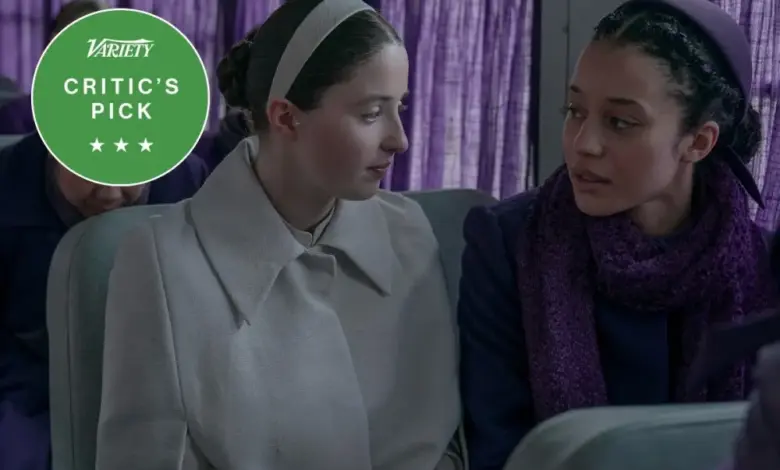
The Testaments returns to Gilead four years after the end of The Handmaid’s Tale, and the timing is unsettling because the new series is not just revisiting a familiar regime. It is shifting the lens to the girls being trained to inherit it. The result is a story about girlhood, survival, rage, and friendship that makes the machinery of control feel even more intimate.
Verified fact: the new series is created by Bruce Miller and adapted from Margaret Atwood’s novel of the same name. Informed analysis: by moving away from June Osborne and toward the young women raised inside Gilead’s privileged class, The Testaments suggests that authoritarian power is sustained not only through fear, but through education, social sorting, and the promise of belonging.
What does The Testaments reveal about Gilead’s real priorities?
The central question is not simply who rules Gilead, but what kind of future it is trying to manufacture. The Testaments centers on young women who have grown up among the privileged class and are being groomed to become the pious wives of the regime’s most powerful men. That premise matters because it shows a system that does not rely only on punishment. It also relies on preparation, routine, and the careful narrowing of choice.
Agnes MacKenzie, played by Chase Infiniti, appears to live a carefully managed life. Her father is a top commander, and her Marthas, Rosa and Zilla, provide warmth and stability inside the home. But the structure around her is rigid. Her stepmother, Paula, is an adversary rather than a nurturer, and her life is increasingly shaped by the expectations of the preparatory school run by Aunt Lydia, with Ann Dowd reprising the role from The Handmaid’s Tale.
That school is where the series makes its first major argument. Agnes and her friends move from Pinks to Plums, then eventually toward Greens and the teal blue of Gilead wives. They are not permitted to read or write, yet they are rigorously tutored for marriage. The system is explicit: once the girls begin menstruating, they become eligible for the marriage market. In other words, The Testaments shows a society that turns female development into a pipeline for obedience.
How does the series turn girlhood into a political weapon?
One of the most revealing details is the contrast between apparent comfort and actual control. Agnes has friends, school, and supervision. She also has a life mapped out in advance. Her best friend Becka is increasingly agitated by the prospect of marriage, while Agnes remains eager to follow the rules. That contrast shows how power operates differently on each girl, even inside the same system.
The arrival of Daisy, played by Lucy Halliday, intensifies that tension. Daisy is a Pearl Girl, one of the young women from outside Gilead who are broken in and trained in the Gilead way. Agnes welcomes her, though Shu warns her, “Get her before she gets you. ” The warning captures the paranoia built into the culture. Loyalty is never only about faith; it is also about suspicion, hierarchy, and survival.
Verified fact: The Testaments shifts among the perspectives of Agnes, Aunt Lydia, and Daisy across its 10-episode first season. Informed analysis: that structure matters because it exposes three angles on the same apparatus of control: the girl being shaped, the enforcer doing the shaping, and the outsider being absorbed into the system.
Why does Aunt Lydia matter so much here?
Aunt Lydia is central because she represents the human face of an inhuman order. In The Testaments, she works alongside Aunt Estee, Aunt Gabbana, and Aunt Vidala to mold the girls into perfect wife material. The names are distinct, but the function is the same: discipline, training, and emotional control. Aunt Lydia’s role links this new series directly to The Handmaid’s Tale while also expanding her importance beyond the original story.
The series also learns more about Aunt Lydia’s origin story and early involvement with Gilead. That detail is significant because it suggests the regime is not maintained by abstraction alone. It is sustained by people whose choices, compromises, and loyalties give the system its staying power. The show’s perspective therefore moves beyond victimization and into the question of participation.
The young women at the center of the series are not presented as symbols alone. They are ordinary teenagers with friendships, rivalries, anxieties, and hopes. That ordinariness is what makes the setting so alarming. The series does not need to announce its warning loudly; it simply shows how a totalitarian order becomes normal when it is repeated in classrooms, homes, uniforms, and rituals.
What is the broader meaning of this follow-up?
The Testaments is described as an exemplary follow-up to The Handmaid’s Tale and a magnificent coming-of-age story. Those descriptions matter because the series is doing two things at once. It continues an established dystopian world, but it does so by focusing on the long-term consequences of indoctrination. The girls are not merely living under Gilead; they are being prepared to reproduce it.
Verified fact: the series draws terrifying parallels to the modern-day experiences of women living in a misogynistic society emboldened by religious psychosis. Informed analysis: that is why the story lands as more than fiction. It frames control over education, marriage, and bodily autonomy as a system that can be normalized when fear is made to look like order.
The Testaments does not need to invent a new threat. It reveals the one already embedded in the old one: a future built by shaping girls into compliant adults. In that sense, the title points to inheritance, but the warning is broader. If institutions can control what young women read, learn, wear, and become, then the most dangerous part of the regime is not its spectacle. It is its method. That is the hidden truth at the center of The Testaments.