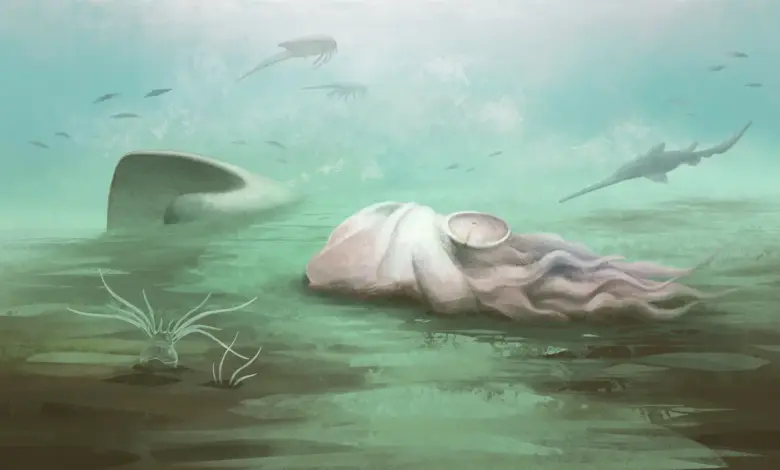
For 26 years, a fossil from Illinois carried a reputation far larger than the rock that held it. Now, a fresh look inside the fossil has changed that story: the specimen once celebrated as the world’s oldest octopus is likely not an octopus at all.
Researchers at the University of Reading say the 300-million-year-old creature, known as Pohlsepia mazonensis, is better understood as a nautilus relative. The finding does more than correct a label. It reshapes a small but important part of the timeline for how octopuses and their relatives evolved.
Why did this fossil seem like an octopus for so long?
The fossil was first described in 2000 after being found at Mazon Creek in Illinois, US. At the time, it appeared to show eight arms, fins, and other features that seemed to fit an octopus. That interpretation was strong enough for the fossil to enter the Guinness Book of Records as the earliest known octopus.
But the new analysis found something more decisive inside the rock. Using synchrotron imaging, which relies on beams of light brighter than the sun, the team was able to scan beneath the surface and uncover tiny teeth in a preserved radula, the rasping tongue found in many mollusks. Dr Thomas Clements, lead author and lecturer in invertebrate zoology at the University of Reading, said the images exposed what had been hidden for years: “The next morning, the images stopped us in our tracks. ”
He added that the fossil’s form had been misleading because it had been decomposing before it was buried and preserved. That decay, he said, made the animal look octopus-like even though the internal evidence pointed elsewhere.
What did the new scan reveal inside the rock?
The clearest clue was the tooth pattern in the radula. Octopuses typically have seven or nine teeth per row, but this fossil showed at least 11. That detail fit better with a nautilus, a shelled cephalopod with modern relatives still living today.
The teeth also matched those of a fossil nautiloid found at the same site. Dr Clements said the work provided “the oldest soft tissue evidence of a nautiloid ever found, ” while also giving a clearer picture of when octopuses first appeared on Earth. The research now supports the view that octopuses emerged during the Jurassic period, much later than this fossil’s original classification suggested.
Alexander Pohle, a paleontologist at Ruhr University Bochum in Germany, said there had been serious doubts about the fossil’s identity for some time and welcomed the detailed work that settled the debate.
What does this mean for octopus evolution?
This is not only a correction about one fossil. It affects how scientists think about the wider family tree of cephalopods. If Pohlsepia is a nautilus relative rather than an octopus, then the split between octopuses and their 10-armed relatives likely happened in the Mesozoic era, not hundreds of millions of years earlier.
That narrows the gap in the record and removes a fossil that had long stood out as an outlier. For researchers, the finding is also a reminder that old specimens can still yield new answers when technology improves.
Dr Clements put it simply: “Sometimes, re-examining controversial fossils with new techniques reveals tiny clues that lead to really exciting discoveries. ” In this case, the clue was not a tentacle, but a row of teeth hidden inside stone.
What happens when museums look again at old specimens?
The story is also a reminder of how museum collections can change with time. The fossil has been housed in the collection of the Field Museum of Natural History in Chicago, and the team borrowed it for the scan. In this case, a specimen studied for decades yielded a new identity only after modern imaging made it possible to look deeper.
Guinness World Records’ managing editor, Adam Millward, said the organization would be resting the original “oldest octopus fossil” title and reviewing the new evidence. That shift closes one chapter, but it also opens another: how many other fossils still hold a different story beneath the surface?
For now, the famous fossil is no longer a marker of the first octopus. It is something more subtle, and perhaps more interesting: proof that even a celebrated fossil can change its name after years of silence in stone.