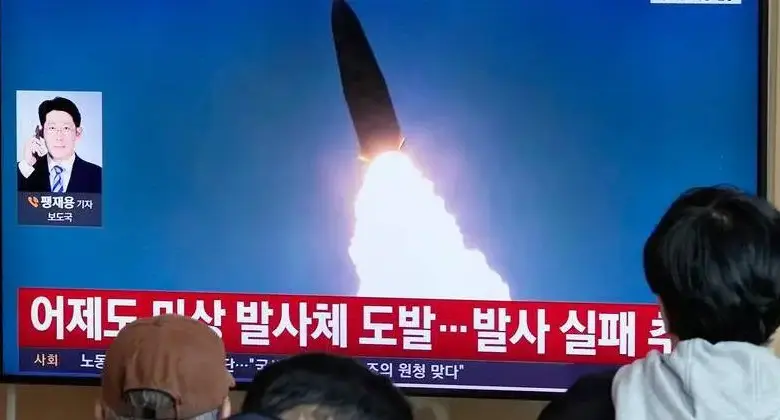
North Korean Ballistic Missiles were fired in two separate launch events within two days, and the pattern points to more than a routine military drill. South Korea’s Joint Chiefs of Staff said several missiles launched from the Wonsan area on Wednesday morning traveled about 240 kilometers toward the North’s eastern waters, while an additional missile later in the day traveled more than 700 kilometers off the east coast.
What is the public not being told about the timing?
Verified fact: the launches came only hours after a senior North Korean official used open contempt toward Seoul’s hopes for warmer ties. Jang Kum-chol, first vice-minister at Pyongyang’s foreign ministry, said South Korea would always remain North Korea’s “most hostile enemy state” and mocked it as “world-startling fools. ” That language mattered because it followed a moment when South Korean officials had treated Kim Yo-jong’s earlier statement as meaningful progress in relations.
Informed analysis: the sequence suggests the missile activity was not detached from the political messaging. The launches, the insults, and the competing interpretations of Kim Yo-jong’s remarks formed a single chain of escalation. The central question is not whether the missiles were launched; that is established. The issue is whether the public is seeing a deliberate rejection of dialogue disguised as routine military signaling.
How did the launches unfold across Wednesday and Tuesday?
Verified fact: South Korea’s military said it first detected an unidentified projectile from North Korea’s capital region on Tuesday. South Korean media said it disappeared from military radars after showing an abnormal development in the initial launch stage, and the launch ended in failure. On Wednesday morning, several missiles were fired from Wonsan, and later an additional missile traveled more than 700 kilometers. South Korea’s Joint Chiefs of Staff said it was maintaining readiness to repel any provocation under a solid military alliance with the United States.
Japanese authorities also issued an emergency alert after announcing that North Korea had launched a suspected ballistic missile. The office of Japan’s prime minister later said officials were instructed to devote maximum effort to gathering and analyzing information and to provide timely updates. Japan’s chief cabinet secretary, Minoru Kihara, said there was no confirmation that missiles entered Japan’s exclusive economic zone.
Verified fact: the US Indo-Pacific Command said it was closely monitoring multiple ballistic missile launches and consulting with regional allies and partners. It said, based on current assessments, the event did not pose an immediate threat to US personnel or territory, or to allies.
Who is being challenged, and who benefits from the confrontation?
South Korea’s liberal government has expressed hopes of restoring long-dormant dialogue, but North Korea has refused to return to talks with South Korea and the United States. The latest launches fit a broader pattern described in the context: North Korea has pushed to expand its nuclear arsenal since Kim Jong Un’s diplomacy with US President Donald Trump collapsed in 2019.
Verified fact: after South Korean President Lee Jae-myung expressed regret over alleged civilian drone flights into North Korea, Kim Yo-jong praised him for honesty and courage while reiterating a threat to retaliate if such flights recurred. South Korean officials called that statement meaningful progress in relations. Jang Kum-chol then said her statement was intended as a warning.
Informed analysis: that gap between Seoul’s reading and Pyongyang’s message is now visible in missile form. The benefit of this posture is not reconciliation; it is leverage. North Korea’s refusal to resume talks, paired with repeated launches, keeps pressure on Seoul, Tokyo, and Washington while reinforcing the image of a leadership that will define the terms of any future engagement.
What does the pattern mean for the next phase?
Verified fact: North Korea has instead sought to strengthen ties with Russia, China and other countries embroiled in confrontations with the United States. That does not explain every launch, but it does clarify the wider environment in which the launches are taking place. Pyongyang has issued no official statement regarding this week’s missile activity.
Informed analysis: the silence is itself part of the message. Without an official explanation, the burden falls on surrounding states to react, interpret, and prepare. The result is a cycle in which North Korean Ballistic Missiles are not only weapons tests but also instruments of political distortion: they obscure intent, force defensive responses, and harden mistrust just when diplomatic language briefly opened a narrow door.
That is why the latest launch sequence should be read with caution and scrutiny. The facts now on the table show a state willing to mix insults, threats, and missile launches while others attempt to preserve the language of dialogue. Until that contradiction is confronted openly, North Korean Ballistic Missiles will keep setting the terms of the regional conversation rather than the other way around.