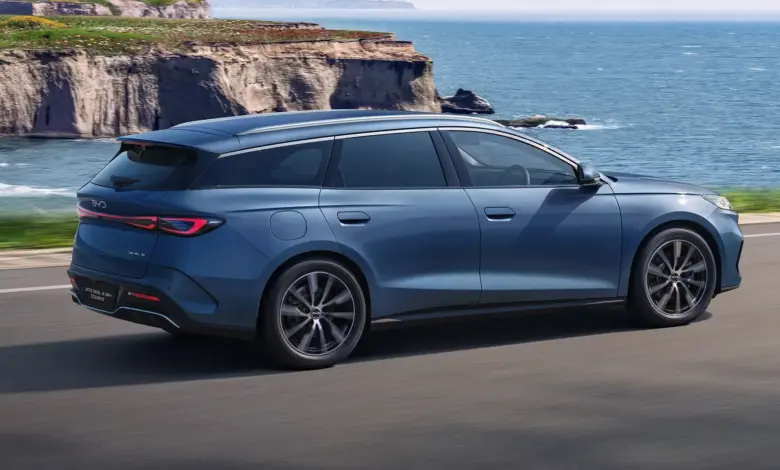
At $34, 990 before on-road costs, byd seal 6 lands with a number that changes the comparison immediately: it sits below the cheapest Toyota Camry Hybrid and does so with electric-only driving capability. That gap is not just a pricing line. It is the clearest sign yet that BYD is using its new plug-in hybrid sedan and wagon to pressure a market segment long defined by Toyota.
Verified fact: BYD has confirmed the Seal 6 Sedan Essential and Seal 6 Touring Premium for Australia, with showroom arrivals expected later this year. Informed analysis: the launch matters because it pairs aggressive pricing with body styles that are still rare in BYD’s local line-up, especially the wagon.
What exactly is byd seal 6 challenging?
The central question is simple: why does byd seal 6 matter so much? Because it is not an SUV or ute, and it arrives as BYD’s first Australian hybrid in a shape that directly targets mainstream family-car buyers. The sedan is similar in size to a Camry or Mazda 6, while the wagon gives BYD something even more unusual: Australia’s most affordable wagon on sale, at $39, 990 before on-road costs.
The sedan starts at $34, 990 before on-roads, undercutting the cheapest Toyota Camry Hybrid at $39, 990 before on-roads. The comparison is sharper because the Camry Hybrid cannot run on electric power alone, while the BYD can. That makes the price difference more than symbolic; it changes the value equation for buyers weighing fuel use, daily driving flexibility and purchase cost.
What do the numbers show about byd seal 6?
The two variants share a plug-in hybrid layout built around a 1. 5-litre non-turbo petrol engine and an electric motor. The sedan uses a 10. 1kWh battery, while the wagon uses a 19kWh battery. Official Australian government documents show the engines in both variants produce 70kW, with the Essential pairing it with a 120kW electric motor for 130kW combined, and the Premium using a 160kW electric motor for 163kW combined.
BYD claims the sedan can deliver 55km of electric-only range and more than 1400km of hybrid range. The wagon is claimed to manage 100km of electric-only range and more than 1300km in hybrid form. Preliminary figures also point to a fast DC charging rate of up to 48kW and a sub-30-minute charge time, while both variants include vehicle-to-load functionality, allowing the battery to power external devices.
Other details make the package more complete. The sedan offers 550 litres of boot space, while the wagon provides 670 litres. Standard equipment includes an 8. 8-inch digital dash, a 12. 8-inch central multimedia screen, wireless Apple CarPlay and Android Auto, and over-the-air features. Available features in overseas specifications include a wireless phone charger, ambient lighting and synthetic leather trim.
Who stands to gain from the pricing strategy?
BYD is clearly benefiting from a broader strategy that treats every new segment as an opportunity to narrow the field against established rivals. The Seal 6 sits alongside the existing Seal EV sedan, but it is positioned as a hybrid alternative rather than a replacement. That gives BYD another route into the family-car market at a time when the brand is expanding quickly in Australia.
The timing also matters. Orders begin on 9 April 2026, with showroom arrivals expected closer to the middle of the year. That schedule gives BYD a runway to frame the Seal 6 as a practical, lower-cost option before it reaches showrooms. In market terms, the pricing places it against the Toyota Camry Hybrid, the Skoda Octavia mild hybrid and the MG7, while the wagon undercuts other mainstream options in a class with limited competition.
How does this fit BYD’s wider Australia plan?
BYD’s local growth is not accidental. Denza Chief Operating Officer Mark Harland, who previously held senior roles in BYD before leading its luxury arm, said in 2025 that Toyota covers about 95 per cent of segments in Australia with at least one variant, and that matching those segments would be necessary if BYD wanted to become number one. That statement helps explain the Seal 6: it is designed to fill a gap, not just sell a car.
Verified fact: BYD has already more than doubled its sales year-on-year in the latest figures, has moved ahead of GWM to become Australia’s favourite Chinese automaker, and sits sixth in the market so far in 2026 after ending 2025 in eighth place. Informed analysis: the Seal 6 suggests BYD is now applying price pressure not only in electric vehicles, but also in the hybrid space where Toyota has long held structural advantage.
What should the public watch next?
The next public test is whether the pricing translates into demand once final local details are fully released. More details are due when orders open on Thursday, 9 April 2026, and the key issue will be whether the claimed efficiency, equipment and sub-$40, 000 entry price hold their appeal against established rivals. For now, the facts point to a deliberate challenge: byd seal 6 is not only cheaper than the Camry Hybrid, it is positioned to make the family-car segment harder to defend without a response.