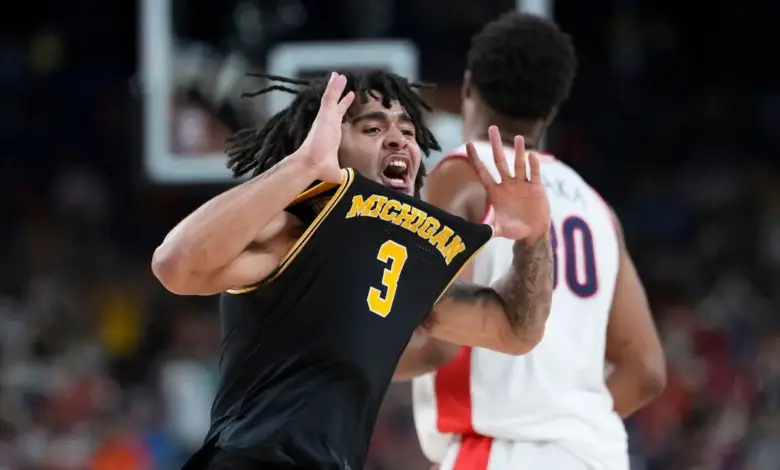
Michigan’s Ncaa Final arrives with a twist that was not obvious when the bracket first tightened: the Wolverines did not merely advance, they flattened Arizona into a 91-73 statement. That matters because the game now turns from a high-scoring semifinal into a meeting with UConn, a team that already handled Illinois 71-62. The biggest question is not whether Michigan has momentum, but whether it can carry the same interior force, perimeter confidence and resilience into a title game that will demand a full 40 minutes of precision.
From semifinal surge to title-game pressure
The semifinal made one thing clear: Michigan’s path to the Ncaa Final has been built on sustained separation. The Wolverines became the first team to break 90 points five times in a single tournament, and they did it while running through a fifth straight March Madness opponent by double digits. Against Arizona, they took control early, built a double-digit lead in the opening minutes and never surrendered the rhythm.
That kind of margin is not just a scoreboard note. It reflects how quickly Michigan can turn a competitive game into one that no longer feels close. Arizona entered with one of the nation’s top defenses and a top-five offense, yet Michigan packed the paint, forced the Wildcats into difficult decisions and dared them to solve the interior problem. They could not. Arizona finished the first half trailing 48-32, and its only two losses before this had been by four and by three in February.
What Michigan’s paint control says about the matchup
The central tactical story in the Ncaa Final is Michigan’s defense at the rim. Arizona averaged the fifth-fewest three-point attempts in the country this season, and Michigan leaned into that profile by giving long-range space while protecting the lane. The result was a lopsided night in which Arizona shot 6 for 17 from three and 36% overall, with only two assists and nine turnovers in the first half.
That approach worked because Michigan never allowed Arizona to settle into its preferred shape. The Wolverines had three blocks and nine dunks, and they looked comfortable imposing physicality rather than reacting to it. For a title game, that is significant because it suggests Michigan is not relying on one hot shooting stretch. It is winning with pressure points that can travel: rim protection, rebounding and a willingness to attack in waves.
There is also the matter of depth and adaptability. Michigan scored despite a disrupted start for Yaxel Lendeborg, who was hurt early, went to the locker room for ice and later returned. His status remains a headline because he is a first-team All-American and one of the team’s most important pieces. Even so, Michigan showed it could survive minutes without him, then expand the lead once he came back with two quick three-pointers in the second half.
Key players and the risk factor behind Ncaa Final momentum
Michigan’s semifinal was not driven by one player alone, though Aday Mara’s career-high 26 points and nine rebounds set the tone. Trey McKenny added 16 points and four made threes, while Elliot Cadeau delivered a chaotic but productive line: 13 points, 10 assists, six turnovers, five rebounds and four steals on 5-for-17 shooting. The numbers point to a team that can absorb uneven shooting nights if the broader system still creates enough pressure.
Yaxel Lendeborg’s injury remains the most important variable entering the title game. He described it as a “weird feeling, ” said he rolled his ankle and sprained his knee, and insisted he would not miss Monday. That promise matters because Michigan’s ceiling rises when he is on the floor, but the semifinal also showed the Wolverines are not reduced to one identity if his minutes are limited. That is a meaningful edge in a game where fatigue and foul trouble can shift everything quickly.
On the other side, UConn arrives with its own title pedigree, going for a third championship in four years. Michigan is seeking only its second championship, with the program’s last title in 1989. The contrast is not merely historical. It frames the pressure: one team is chasing a return to the top, the other is chasing continued dominance.
Why this Ncaa Final could be decided by pace, not reputation
Dusty May called his team battle-tested, and that phrase may define the matchup better than any ranking or seed line. Michigan’s run has included repeated double-digit wins, but the deeper takeaway is how quickly the Wolverines can force opponents into chasing them. When they build leads early, they control pace, shot selection and emotional tone. When they do not, the game becomes a different test entirely.
That is why the title game is less about reputation than execution. UConn’s semifinal win over Illinois shows it is prepared for a different kind of contest, and Michigan’s path through Arizona shows the Wolverines can overwhelm teams that are not ready for their physical and offensive bursts. The question is whether that formula still works when the opponent is championship-tested and the margin for error shrinks.
In that sense, the Ncaa Final is less a reward for Michigan than a stress test of everything the Wolverines have built: paint defense, shot-making, frontcourt size and composure under pressure. If they carry the same intensity into Monday, the game may again tilt before halftime. If not, the first true crisis of their tournament could arrive with a title on the line.