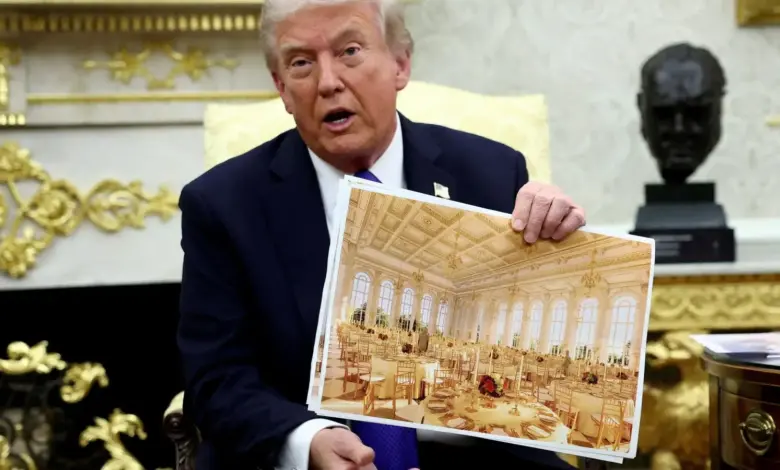
At the site where the East Wing once stood, bulldozers have fallen quiet and plans for the trump ballroom sit frozen under a court order. The National Trust for Historic Preservation secured a preliminary injunction that temporarily stops work on the 90, 000sq ft project on the demolished East Wing footprint.
What did the judge decide about the Trump Ballroom?
US District Judge Richard Leon granted the preservation group’s request for a preliminary injunction, pausing construction while the legal challenge proceeds. In his written comments Judge Leon said: “I have concluded that the National Trust is likely to succeed on the merits because no statute comes close to giving the President the authority he claims to have. ” He added a wider constitutional frame: “The President of the United States is the steward of the White House for future generations of First Families. He is not, however, the owner!” The judge suspended enforcement of his order for 14 days, noting that stopping an ongoing construction project can raise logistical issues.
Why did the National Trust sue, and what are the competing claims?
The National Trust for Historic Preservation filed the first suit after the administration demolished the East Wing, a structure first built in 1902 and later expanded under Franklin Roosevelt. The group argues that neither the president nor the National Park Service had the authority to remove the historic structure or to build a replacement without congressional approval. A later legal bid was launched and initially rejected by Judge Leon, who characterized the earlier challenge as built on a “ragtag group” of legal theories and invited an amended complaint, which the group filed.
On the other side, the project has been advanced by the president and private donors. The construction has been described by the president as privately funded and positioned as a defining addition to the White House. The president has characterized the preservation group in harsh terms, calling it “a radical left group of lunatics whose funding was stopped by Congress in 2005, ” and has defended the project as “under budget, ahead of schedule, being built at no cost to the taxpayer, and will be the finest building of its kind anywhere in the world. ” He has also said the ballroom will hold 999 people.
What are the immediate human and institutional consequences?
The pause puts donors, contractors and the White House’s legacy plans into legal limbo. The suit spotlights institutional checks that preservationists say were bypassed: the plan advanced without input from federal review panels that normally evaluate changes to the capital — the National Capital Planning Commission and the Commission of Fine Arts. The president has stacked both commissions with allies, a factual point raised in the litigation timeline. For preservation advocates, the case is about the stewardship of a public place built and modified across presidencies; for the president and supporters, it is about completing a major privately funded enhancement that they describe as part of a presidential legacy.
Judge Leon’s ruling functions as an authoritative legal voice in the dispute. His declaration that the president is a steward, not an owner, reframes the controversy as a question about institutional limits and the role of Congress in changes to federally significant property. That legal framing will guide the next steps in the courthouse and shape how participants present their evidence and claims.
Voices on both sides are unmistakable. The National Trust has pursued multiple legal avenues since the demolition. The president has responded with public outrage and direct quotations defending the project and criticizing the preservation group. The contest now plays out as a courtroom struggle over heritage, authority and how the White House should evolve.
The injunction does not settle the matter; it only halts construction while the court weighs the parties’ claims. The suspended enforcement period gives time for legal maneuvering and for the practical complications of stopping a construction site to be addressed.
Back at the emptied footprint of the East Wing, the halted cranes and the quieted work crews are a visible reminder that legal limits can block even well-funded, high-profile projects. The preservation group’s action has forced a judicial examination of presidential power tied to the public stewardship of the White House, leaving donors, advocates and the public waiting for the next chapter in a contest over history and authority.
The trump ballroom now exists as both a design on paper and a legal question in a federal courthouse — a test of whether private funding and presidential ambition can override statutory and historical restraints.