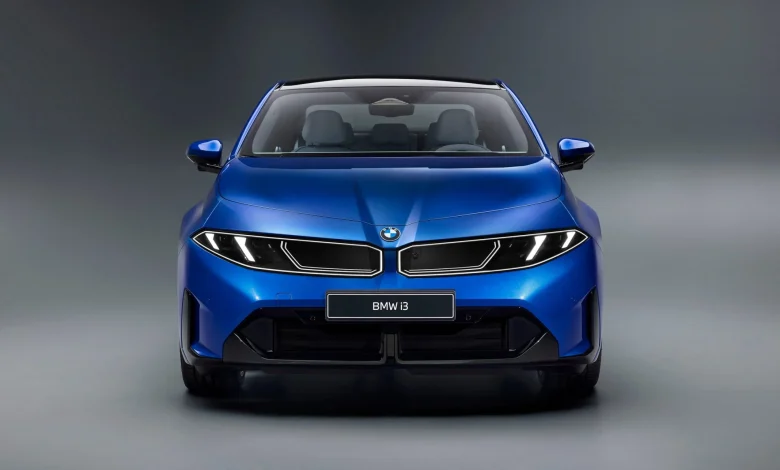
The bmw i3 arrives as a defining moment for BMW’s Neue Klasse shift: an electric sedan that translates tight, familiar 3-Series proportions into a battery-powered package built on the same platform and electrical architecture as the iX3.
What Happens When Bmw I3 Recasts the 3-Series DNA?
The i3 is presented as an evolution rather than a rupture: a Neue Klasse sedan that keeps signature elements such as a forward-leaning stance, short overhangs, the Hoffmeister kink and recognizable headlight and taillight motifs while removing the traditional open kidney grille and replacing it with a twin-kidney LED graphic. BMW chief executive officer Oliver Zipse featured the i Vision Dee concept as a visual antecedent for the production i3; the first production model is the battery-electric i3 M50, which uses dual electric motors and an all-wheel-drive layout.
What If the Platform and Hardware Deliver on Efficiency, Range and Charging?
The i3 sits on the Neue Klasse architecture already used by the iX3 and inherits its 800-volt electrical system, next-generation motors and a shared battery pack. Powertrain figures for the M50 are stated at about 463 horsepower with torque quoted in close figures in preview material; charging capability and energy strategy are a clear focus: both the i3 and iX3 are described as supporting peak DC fast-charging rates of up to 400 kW, and the i3’s lower profile is tied to an estimated 440-mile EPA range. Vehicle-to-load reverse charging is offered as an option in the i3 lineup.
- Platform: Neue Klasse (shared with the iX3)
- Electrical architecture: 800-volt system
- Launch powertrain: i3 M50 dual motors, approximately 463 hp
- Charging: peak DC fast charging up to 400 kW
- Range: estimated 440-mile EPA figure
- Dimensions cited for comparison with iX3: identical 114. 1-inch wheelbase and a tightly wrapped sedan profile
What Comes Next for bmw i3 — Winners, Risks and What to Watch?
Winners will include buyers seeking a conventional sport-sedan silhouette with long electric range and high-speed charging capability, and BMW’s engineering teams that have moved a Neue Klasse concept into a production sedan that aims to marry tradition with electric architecture. The i3’s design choices—LED kidney graphic, concealed sensor arrays, and a low-slung profile—are positioned to preserve BMW’s driving-oriented proportions while adapting packaging for an underfloor battery.
Risks include debate over styling decisions that abandon large physical grilles for lighting graphics and the reception to the i3’s reinterpretation of familiar cues. Execution challenges hinge on real-world charging and range performance, and on whether additional variants—single-motor versions and more performance- or M-focused drivetrains—arrive as outlined in preview material.
The next inflection will be how the market responds to an EV that is explicitly described as the Neue Klasse sedan equivalent to the 3-Series: a compact, long-wheelbase electric sedan that shares core hardware with the iX3 and emphasizes range, charging speed and a modernized BMW design language. Stakeholders should watch official specifications and availability windows as BMW transitions the lineup to this new architecture; the bmw i3 closes this piece as the company’s bet on a new class of electric sedans.