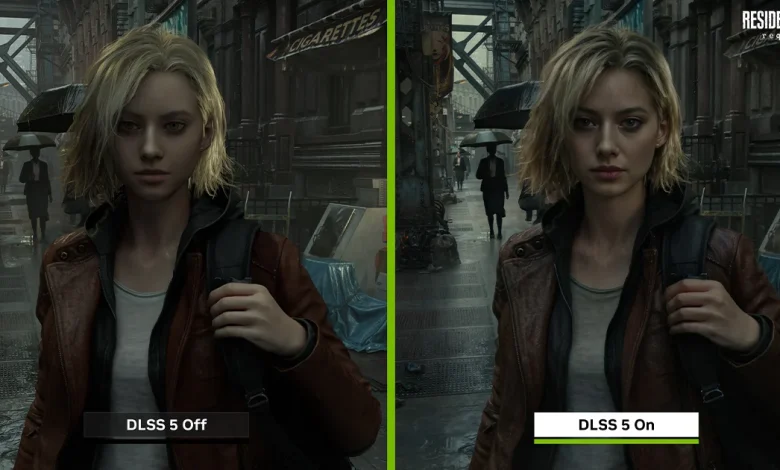
dlss 5 is billed as an AI-driven leap that will deliver photo-realistic lighting on today’s hardware even as NVIDIA projects up to 1, 000, 000 times better path-tracing performance in future GPUs — a contrast that reframes what gamers and developers are being asked to accept now versus what the company says is coming later. Which claims are demonstrated now, and which remain roadmap ambition?
What is Nvidia claiming about Dlss 5?
Verified facts: NVIDIA presented Dlss 5 at its GTC 2026 event as an AI lighting model distinct from prior DLSS features. NVIDIA described Dlss 5 as not being a frame-rate, frame-generation, or traditional performance-enhancing technology but as a machine-learning model that transforms lighting and material response using only colour information and motion vectors. NVIDIA says the AI network powering Dlss 5 recognises scene semantics such as skin, hair, water and metal and applies differentiated, photo-realistic lighting effects while leaving geometry, textures and materials unchanged. NVIDIA has framed Dlss 5 as capable of operating on rasterised, ray-traced and path-traced content and positioned it as a tool to help developers achieve artistic goals beyond present hardware limits.
Analysis: Those descriptions position Dlss 5 as an image‑level lighting replacement rather than a traditional renderer upgrade. The claim that the model uses only colour and motion vectors implies a tight integration point with engines, but NVIDIA’s own material notes that the technology is a snapshot of work-in-progress and will receive further optimisations before launch.
Which games, GPUs and timelines were demonstrated for Dlss 5?
Verified facts: Demonstrations of the technology were shown in current shipping games and a forward-looking demo. Titles cited in demonstrations include Resident Evil Requiem, Hogwarts Legacy, Assassin’s Creed Shadows, Oblivion Remastered and Starfield. NVIDIA set a target to bring Dlss 5 lighting to RTX 50-series GPUs by Fall 2026 and described the project as the product of three years of in-house development, with a launch slated later in 2026. Observers of early demonstrations noted generational leaps in character and environment rendering but also identified some screen-space errors in the present snapshot.
Analysis: Showcasing Dlss 5 on existing titles signals a push to retro-fit games with AI-crafted lighting without reauthoring assets. The simultaneous acknowledgement of visible artefacts and a multi-year development timeline underscores that the public demonstrations are preview quality rather than a finished consumer feature.
What does NVIDIA’s path-tracing roadmap mean for realism and accountability?
Verified facts: At a developer presentation, John Spitzer, Dev & Performance VP, NVIDIA, presented a trajectory in which current Blackwell-era gaming GPUs were positioned as about 10, 000 times faster in path-tracing performance than Pascal-era hardware. The company also articulated a longer-term goal of reaching 1, 000, 000 times better path-tracing performance in future generations. John Spitzer characterised transistor-scaling alone as insufficient to reach photorealism, framing AI and neural rendering as the catalyst. NVIDIA CEO Jensen Huang has likewise positioned neural rendering as central to future visuals. The presentation included references to new path-tracing technologies—ReSTIR and RTX Mega Geometry—and a Witcher 4 demo claimed to contain over two trillion triangles to illustrate potential geometry and lighting complexity.
Analysis: The juxtaposition of near-term AI enhancements (Dlss 5) with a multi‑generation hardware roadmap creates a dual narrative: immediate visual uplift through neural processing, and a promise of massive hardware gains later. For developers and consumers, that raises questions about where engineering effort and expectations should be focused now, and what metrics will verify each step of the roadmap.
Accountability and call to transparency: Verified facts show NVIDIA coupling demonstrated, ship-ready previews of Dlss 5 with bold multi‑generation performance targets. To move from demonstration to dependable deployment, NVIDIA should publish developer integration guidance, clear artifact and performance baselines for Dlss 5 on RTX 50-series hardware, and reproducible benchmarks tied to the path‑tracing performance claims presented by John Spitzer and Jensen Huang. Clear timelines, measurable success criteria, and open developer tools will allow creators and players to judge when the promised photo-realism transitions from preview to dependable reality.