Rugby World Rankings: England’s Fall and Argentina’s Rise — Five Shifts That Reshaped a Weekend

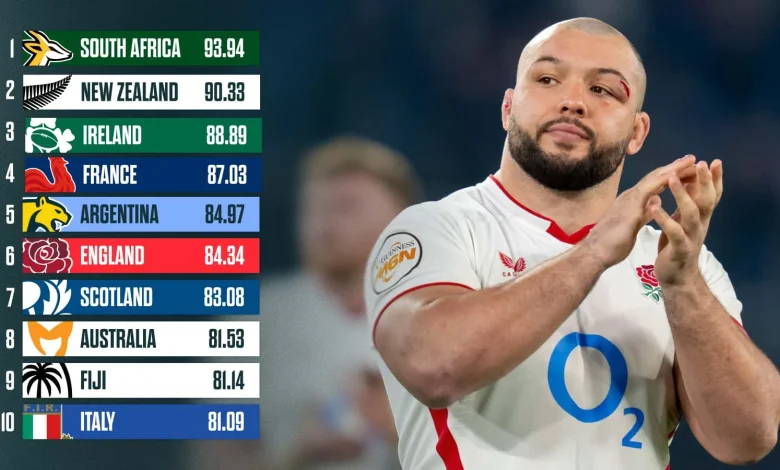
The Six Nations and the Rugby Europe Championship produced seismic movement on the rugby world rankings within a single weekend. The word on every scoreboard was movement: England tumbled after a first-ever Six Nations defeat to Italy, Argentina moved up a place, and Scotland’s high-scoring win over France produced clear rating-point change. Those shifts have reopened permutations for third place among northern powers and left recalibrations across the middle of the table.
Background & context
The current table shows South Africa and New Zealand firmly at the summit with 93. 942 and 90. 333 rating points respectively, a gap that could not be closed by weekend results. Ireland sat third at 88. 894, France fourth at 87. 03 after losing 1. 37 rating points, and Argentina climbed to fifth at 84. 97. England dropped to sixth on 84. 34 after losing 1. 28 points following Italy’s historic win. Scotland’s 50-40 victory over France earned them 1. 37 rating points and left them seventh on 83. 08, while Italy gained 1. 28 points and occupy 10th on 81. 09.
Those raw numbers frame immediate consequences: England, despite finishing the prior year as high as third, have slipped after three straight defeats in the Championship. Italy registered a first-ever Six Nations win over England in 33 meetings, and Argentina’s upward move made them the biggest mover among the top half on the published table.
Rugby World Rankings: Analysis and regional impact
The ranking permutations are now sharper and more conditional. For one, the summit remained unchanged regardless of weekend outcomes; no team could surpass South Africa or New Zealand in the immediate sequence of fixtures. The contest for the highest-ranked Six Nations side, however, tightened: Ireland occupy pole position to retain third provided they avoid defeat to Scotland, leveraging an 11-game winning run against Scotland dating back to a loss in 2017. France can displace Ireland for third if they beat England and Scotland end Ireland’s streak, while England still have a mathematical path back into third if they deliver a big-margin win in Paris and other results fall their way.
England’s fall to sixth is numerically significant: the team lost 1. 28 rating points and now sit behind Argentina, which rose by one full point. That exchange illustrates how a single upset — Italy’s historic victory — can shuffle positions across multiple tiers. Scotland’s 1. 37-point gain did not lift them past seventh, but it closed the gap to the teams above and demonstrated the volatility mid-table matches can create. Italy’s gain of 1. 28 points pushed them above both Australia and Fiji in provisional assessments, showing how breakthrough results in major regional competitions prompt upward movement.
Beyond the top 10, the weekend also left developing narratives: Georgia stand poised to equal an all-time high if they secure a large win in their regional contest, while Portugal could make a two-place leap if they phase a surprise result. Wales face potential decline absent a win, and Spain, Uruguay and others remain within relatively narrow margins that respond quickly to single-match swings. Those dynamics matter for seedings, preparatory planning and the broader competitive map ahead of the next cycle of fixtures.
Expert perspectives and what to watch next
Steve Borthwick, Head Coach, England: the facts show England arrived at the weekend after a 12-match winning run that had previously lifted them to third; subsequent results left the side sixth and facing a set of specific numerical conditions to climb back up the table.
Andy Farrell, Head Coach, Ireland: Ireland’s position at third is contingent on avoiding defeat to Scotland to retain the highest Six Nations ranking, and their historical 11-match winning sequence against Scotland provides context for how narrow outcome margins translate into rating stability.
Gregor Townsend, Head Coach, Scotland: Scotland’s 50-40 win over France generated a 1. 37-point gain and demonstrates how an emphatic result against a top-four opponent alters short-term momentum even if it did not immediately leapfrog them into the higher tier.
All three coaching situations are now test cases in how teams convert narrow rating margins into strategic advantages. The immediate calendar includes fixtures where point margins matter — not only win or loss — and where a 15-point swing can determine whether a nation climbs, holds, or falls on the ladder.
Looking ahead, the question for teams, administrators and fans is operational: will the sides displaced by this weekend respond with corrective selection and tactical shifts, or will the upward movers consolidate their new status? The answers will play out in margins and minutes rather than headlines alone, and that is the clearest lesson from the recent reshuffle of the rugby world rankings.
Which teams will translate this weekend’s movement into sustained progress on the ratings map, and who will be the next to change places?