Banksy: A Secret Market, Corporate Filings and a Claimed Unmasking That Rewrites the Street Artist’s Story

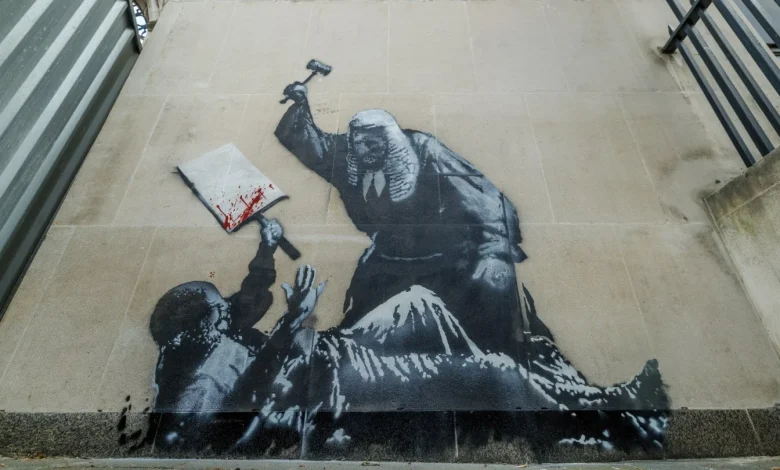
In a dim Shoreditch basement on Hanbury Street, collectors circulated around works freshly shown behind low ropes as flashbulbs furtively clicked. The room smelled of damp concrete and cheap coffee; names were rarely spoken, and every sale came with a signed nondisclosure and a three‑year non‑resale agreement. The scene, attendees say, is part of how banksy now reaches a select clientele while most of his works change hands elsewhere.
Who do investigators say Banksy is?
A recent investigation claims the anonymous artist long known as Banksy is Robin Gunningham, a man said to have later taken the name David Jones. The inquiry draws on a range of materials cited by its authors, including photographs from Ukraine, a fallout with photographer Peter Dean Rickards who is said to have posted images, and a handwritten confession from a 2000 arrest in New York. The investigation also argues that the artist is not Robert Del Naja, the musician who has been the subject of longstanding speculation. Mark Stephens, who identifies himself as the artist’s lawyer, wrote that his client “does not accept that many of the details contained within [the] enquiry are correct” and warned that publishing such claims would “violate the artist’s privacy, interfere with his art and put him in danger. ” Stephens added that anonymity “protects freedom of expression by allowing creators to speak truth to power without fear of retaliation, censorship or persecution. ”
How has Banksy’s art generated millions, and who benefits?
Court filings and company records sketch a parallel story: an opaque commercial structure and a booming secondary market. Data from ArtTactic places secondary‑market sales of Banksy works at about US$248. 8 million since 2015. The artist receives a small fraction of those resales under a U. K. legal provision that pays royalties to creators, while private sales to VIP collectors may channel significant sums directly. Corporate documents name a cluster of British firms connected to the artist, anchored by the Pest Control Office, incorporated in 2008, which serves as an authentication and business body. Its parent, Picturesonwalls Limited, once operated a gallery and shows rising net assets in filings at Companies House.
Those filings trace growth from modest early balances to multi‑million‑pound positions: Pest Control’s first report listed total assets in the low hundreds of thousands of pounds, later growing into millions, including several million held in cash and in unspecified “stocks. ” Picturesonwalls Limited’s net assets rose dramatically from its initial reporting period to amounts in the low millions. Early in the artist’s career, prints sold through the gallery for as little as £60; the gallery closed in 2017 with a sardonic farewell saying “disaster struck” when its artists became successful and prints became worth tens of thousands of pounds.
What are the responses and what does this mean for collectors and the public?
Market practitioners and academics express contrasting views. Ulrich Blanche, an art historian, puts the dynamic plainly: “It’s very hard to buy a Banksy from Banksy. ” That scarcity fuels private markets and high valuations, while the artist’s formal structures — authentication by Pest Control, corporate accounts filed at Companies House, and tightly controlled private showings — create both a mechanism for control and an opacity that frustrates wider transparency.
The secret Shoreditch exhibition referenced by attendees included works described by those present: a print of a child sitting in a flowering tree that sold for £15, 000 and a Madonna with Child painted on scrap metal with a rusty bullet hole that fetched £500, 000. Buyers at that event signed nondisclosure agreements and non‑resale covenants lasting three years, underscoring how parts of the market operate well outside public auction rooms.
For the public, the converging narratives — a claim of identification on one hand, and corporate filings showing a deliberate, guarded business on the other — raise questions about anonymity, accountability and artistic intent. The artist’s lawyer frames anonymity as a shield for free expression; historians and market analysts point to the structural mechanisms that turn ephemeral street interventions into durable financial assets.
Back in that Shoreditch basement the hush held a different meaning than it might on a city wall: it was not only about secrecy but about control — who gets to own the work, under what terms, and who decides what counts as authentic. The answers remain contested, and both the claimed unmasking and the company accounts have added layers to a story that has always mixed provocation with commerce.
As attendees folded their papers and left the basement to rejoin a rain‑slicked street, the question hung in the air: will these new revelations change how the work is seen in public space, or simply redraw the boundaries of a market the artist helped make possible?