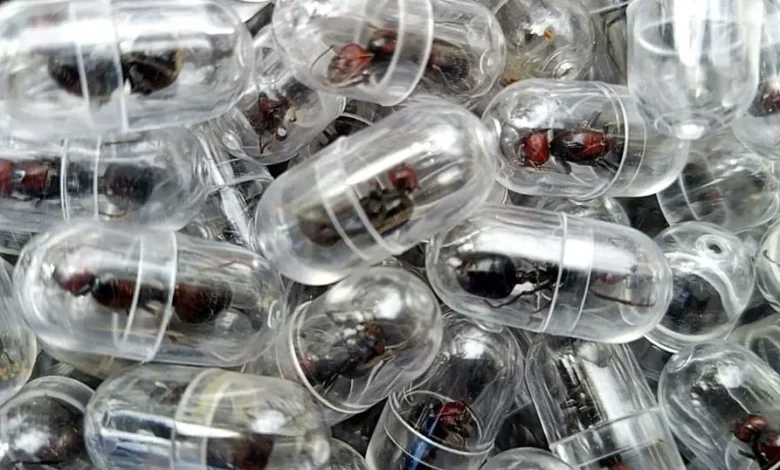
A Chinese national was arrested at Nairobi’s main airport after security personnel uncovered more than 2, 000 live queen ants hidden in his luggage.
What Happens When Queen Ants Are Trafficked?
Prosecutor Allen Mulama told the court that the suspect, named Zhang Kequn, was intercepted during a security check at Jomo Kenyatta International Airport while attempting to board a flight bound for China. Mulama said investigators recovered 1, 948 garden ants packed in specialised test tubes and a further 300 live ants concealed in three rolls of tissue paper within the luggage. The ants are identified in court papers as the garden ant Messor cephalotes, a species protected under international biodiversity treaties with tightly regulated trade.
Duncan Juma, a senior Kenya Wildlife Service official, said investigators expect further arrests as the probe expands into towns where ant harvesting is suspected. The court allowed prosecutors to detain the suspect for five days so detectives can examine electronic devices including a phone and a laptop.
- Methods observed: concealment in test tubes and tissue rolls; targeted export in passenger luggage.
- Enforcement signals: short-term detention for forensic review of electronics; linkage to a trafficking network dismantled last year.
- Conservation concern: Kenya Wildlife Service notes removal of these ants can disrupt soil health and biodiversity.
What If the Investigation Expands?
Current court statements link the arrest to a broader ant-trafficking network that was broken up in Kenya last year. Prosecutors have said Zhang may have connections to that ring and that he apparently escaped Kenya last year using a different passport. Last May, a Kenyan court sentenced four people—two Belgians, a Vietnamese and a Kenyan—to one year in prison or a fine for attempting to smuggle thousands of live queen ants; the Kenya Wildlife Service described that outcome as a landmark ruling.
Three plausible near-term scenarios emerge from the facts presented in court:
- Best case: Forensic review of devices and follow-on arrests replicate last year’s coordinated operation, shutting down collection points and deterring buyers in Europe and Asia where demand has been highlighted.
- Most likely: Continued piecemeal arrests and prosecutions expose parts of the trafficking chain but leave collectors and some cross-border buyers active, maintaining pressure on wild populations and enforcement resources.
- Most challenging: Networks adapt concealment methods and routes, increasing extraction from remote areas and causing measurable harm to soil processes and biodiversity where these ants play an ecological role.
Given the evidence presented in court and statements from Kenya Wildlife Service officials, officials and stakeholders should anticipate an expanded probe, targeted forensic work on electronic devices, and additional detentions as investigators pursue links to the dismantled network. The public should watch for enforcement outcomes and any follow-up prosecutions that clarify how trade channels and demand in Europe and Asia are being addressed. The immediate priority remains protecting ecosystems and enforcing regulations to stem the illicit trade in queen ants