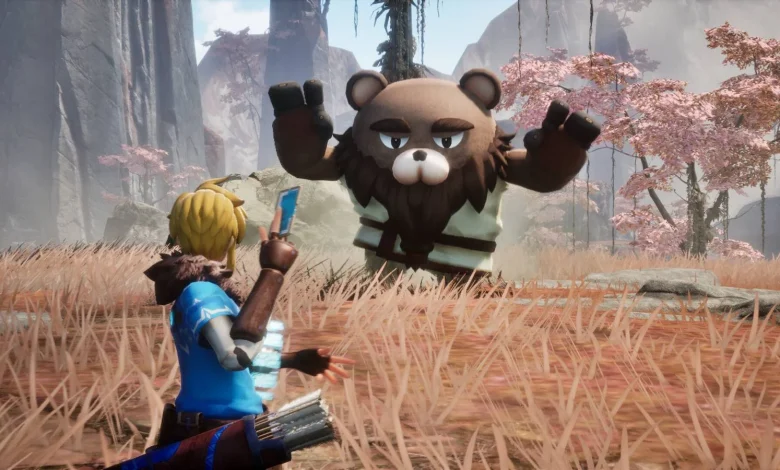
The pickmon game trailer begins with a Link-like figure gliding across a ruined plain while a brightly colored creature that recalls other popular monsters streaks past — a scene that reads less like homage than like an index of familiar pieces rearranged. The footage that followed shows characters teaming with monstrous companions to fight, farm and build, while another shot inexplicably includes a character that evokes a well-known Overwatch hero.
What is Pickmon Game and why does it look so familiar?
PickMon is presented as a multiplayer open-world survival crafter from developer PocketGame and publisher NETWORKGO, the latter of which previously released a fantasy title named Hainya World. The game’s promotional material describes players who will “dive into a vast, uncharted continent filled with ancient civilizations and mysterious creatures called ‘Pickmon. ‘” That material also promises players will “team up with the monsters to fight enemies, gather resources, farm land, and build sprawling ‘industrial empires. ‘”
Critics of the listing point to visual and mechanical echoes of major franchises: creatures and silhouettes that remind viewers of established designs, a central protagonist visually similar to recent Link incarnations, and imagery that borrows aesthetic cues associated with monster-taming games and open-world adventures. In one reveal clip, a character who resembles Roadhog from Overwatch appears, raising questions about how far the trailer’s borrowings extend.
How are rights holders and courts already shaping this landscape?
Nintendo’s recent legal activity frames much of the current conversation. The company is engaged in a litigation with the studio behind another monster-taming title, a dispute that centers on patents related to monster-summoning mechanics. Japanese authorities rejected part of Nintendo’s patent attempt, and the U. S. Patent and Trademark Office took the unusual step of re-examining one of Nintendo’s previously granted patents. Separately, Nintendo has filed suit in the United States Court of International Trade challenging tariffs imposed under executive orders, arguing the duties were unlawful and seeking refunds with interest.
Those parallel fights — over intellectual property and trade policy — matter because they show how companies deploy courts and agencies to protect business models and market positions. Nintendo’s record is mixed: while it often defends its intellectual property aggressively, it has not been uniformly successful, as demonstrated by a trademark dispute in which a grocery store named “Super Mario” successfully defended its mark in Costa Rica.
What are the human and economic stakes for creators and players?
For small studios like PocketGame and publishers like NETWORKGO, releasing a conspicuous mashup can draw attention quickly and generate traffic for a storefront listing or trailer. For players, the draw is familiar mechanics and characters wrapped in a new package: teaming with creatures, crafting, farming and building industrial empires are explicit selling points.
For established rights holders, the stakes are reputational and financial. Past litigation over a similar title hinged on patents rather than character designs, and agencies have shown willingness to reconsider patents that companies view as core to their franchises. For the legal teams and executives involved, each new high-profile knockoff becomes both a potential infringement case and a test of where courts and patent offices will draw lines.
Blizzard Entertainment’s ownership of a particular character design is also invoked in commentary about the trailer, illustrating how multiple rights holders can be implicated when a new product borrows from several sources.
Some industry observers have labeled the moment “knockoff singularity” because a single listing can mirror multiple franchises at once, compressing many familiar elements into a single commercial pitch.
What is being done? Developers and publishers are releasing trailers and storefront listings; rights holders are pursuing litigation and administrative reviews of patents and tariffs; courts and patent offices are taking procedural steps that could affect outcomes. The practical effect is an industry negotiating the boundary between inspiration and infringement through legal filings, agency reviews and public scrutiny.
Back at the trailer’s opening frame, the Link-like figure cuts a lonely silhouette against the ruined skyline. That image, once merely evocative, now reads as an emblem of wider tensions: an independent creator seeking attention, established brands defending legal ground, and regulatory bodies deciding how much similarity is too much. Whether PickMon endures as a playable world, a legal test case, or simply a footnote will depend on those proceedings — and on whether audiences find anything in the mashup that feels genuinely new.