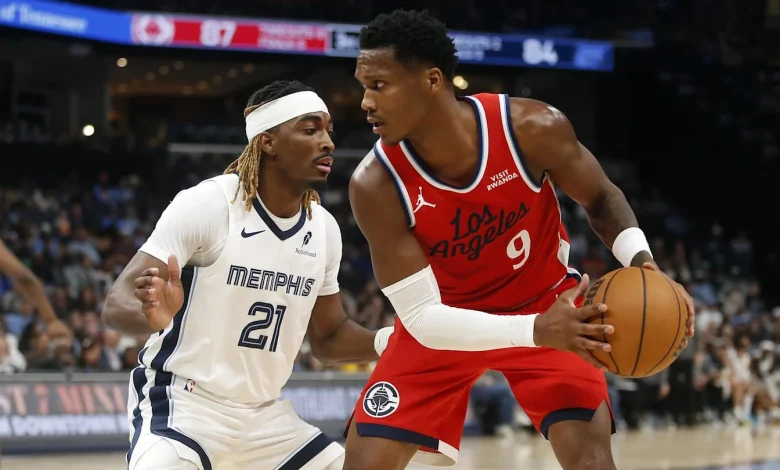
bennedict mathurin has delivered high-impact scoring bursts since joining the Los Angeles Clippers, but an 11-game sample exposes efficiency and playmaking gaps that shape a clear offseason dilemma.
What Happens When Bennedict Mathurin’s Scoring Eruptions Meet Efficiency Concerns?
The Clippers are on track to make the postseason, with Darius Garland back healthy and Kawhi Leonard performing at a near-MVP level. Into that context, Mathurin has provided flashes that complicate roster decisions: multiple 20-point nights and a 38-point outing in his third game as a Clipper, plus a 23-point, 8-for-11 performance in 22 minutes against his former team that also included eight rebounds, four assists, one steal, and one block.
Those highs coexist with a set of quantifiable shortfalls across an 11-game stretch in Los Angeles. Mathurin is 6-for-38 from three-point range (15. 8%) and carries a 27: 23 assist-to-turnover line. At a 28% usage rate, his True Shooting percentage sits at 53. 1—below league-average efficiency—and the Clippers’ offensive rating has been 4. 3 points per 100 possessions worse with him on the floor than without him. The tradeoff is clear: top-end scoring upside that can change a game, and a collection of metrics that cap the offense when he operates as a high-volume option.
What If the Clippers Prioritize Fit Over Volume?
Decisions fall into a small set of choices grounded in the available facts. Mathurin’s strengths—getting to the rim, finishing through contact, drawing fouls and creating for himself—are real. His struggles—three-point shooting, turnover frequency relative to assists, and overall efficiency—are equally real. That tension creates three practical vectors for the Clippers this offseason: reduce his usage and leverage his bench scoring; design lineups that limit inefficient possessions while maximizing his finishing; or press him into a high-usage role and accept the offensive drag when he is inefficient.
- Key metrics at a glance:
- 3P: 6-for-38 (15. 8%)
- Assist-to-turnover: 27: 23
- Usage rate: 28%
- True Shooting%: 53. 1
- Offensive rating split: -4. 3 points per 100 possessions (with vs. without)
Former Pacers head coach Rick Carlisle publicly praised Mathurin’s scoring and framed the new pairing with Kawhi Leonard as a “great 1-2 punch, ” calling Mathurin “another Kawhi Leonard-type scorer. ” That external validation underscores why the Clippers acquired him: his scoring ceiling is not in doubt. The question for decision-makers is whether that ceiling can be leveraged without allowing his complementary deficiencies to cap the team’s ceiling in high-stakes playoff possessions.
What Should the Clippers Do Next?
The immediate operational choices are straightforward and stem from the facts at hand. One path is to preserve Mathurin’s scoring bursts in shorter stints that protect offensive efficiency; another is to explicitly rework his role so that playmaking responsibilities—and the turnovers that come with them—are constrained; a third is to invest in targeted development aimed at stabilizing his three-point shooting and decision-making, thus converting volatility into scalable value.
All paths carry tradeoffs. Reducing usage preserves team offense but limits the high-end scoring he can provide. Entrusting him with volume risks further efficiency drag. Investing in development requires time the Clippers may have limited if postseason urgency is immediate. Given the Clippers’ current standing and the dual facts of Mathurin’s explosive scoring and his troubling efficiency and turnover profile, the offseason conversation will rightly revolve around how to balance upside and liability around bennedict mathurin