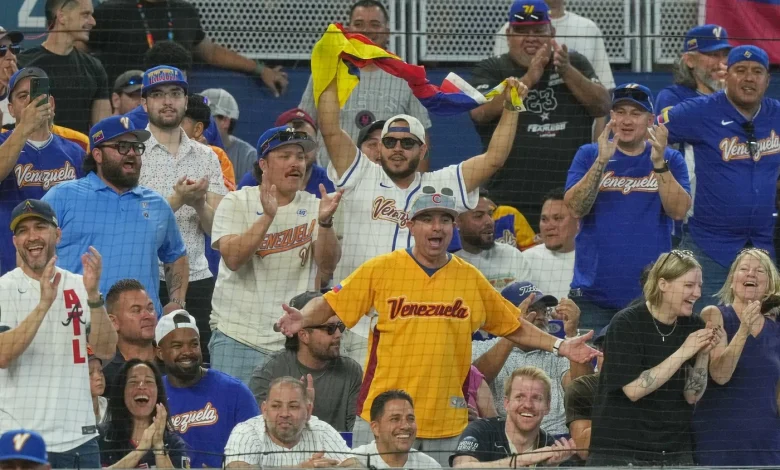
Outside loandepot park, music pulsed and flags flew as fans in yellow, blue and red lined up more than an hour before first pitch. Vendors displayed jerseys on improvised racks; people painted their faces and draped national colors across their shoulders. Inside, the third-base side hummed with the kind of collective expectation that turns a ballpark into a temporary hometown.
What happened at Loandepot Park during Venezuela vs. Netherlands?
The game unfolded as a celebration for Venezuelan fans and a milestone on the field. Willson Contreras, who had two hits and two RBIs for Venezuela, helped drive a 6-2 victory over the Netherlands in Pool Play. Ronald Acuña Jr. scored from third base early in the contest, and several teammates leapt over the dugout railing to join a spontaneous celebration. The stadium’s lower deck, especially on the third-base side where Venezuela’s dugout sat, held the bulk of the crowd’s cheers.
Why did fans treat the game as joy rather than a political event?
For many in the crowd, the game was an opportunity for communal pride separate from political headlines. Jessalyn Suarez, an office manager from Miami, said the day was about joy and not about politics. Jesus Otero, a retired heavy machine operator from Hialeah, expressed a similar sentiment: “He’s not here, ” he said when asked about political figures, signaling that fans were focused on the team on the field.
That focus was reflected in the atmosphere: music from popular Latin artists played outside the ballpark, a gas station vendor displayed jerseys and caps, and families and friends arrived well before first pitch. Nelson Zurita, a Venezuelan who lives in Chile and traveled to Miami for the tournament, described Venezuelan baseball fans as motivated and deeply involved with everything that happens with the team; he said the country will always be focused on sports, and that the players do not want to mix politics with baseball.
How are team leaders and players navigating geopolitically charged surroundings?
Omar López, manager of Team Venezuela, has been explicit about staying on the field and off political debate. López noted he has spent nearly three decades in baseball and said he will not discuss political situations around his country; his presence with a Venezuelan flag stitched on his cap, and an American flag a few feet away, underlined the complex backdrop without turning the game into a forum for policy disputes.
Players shared that sentiment. Javier Sanoja, a utilityman for the Marlins, said he was “super happy” to be in Miami because it felt close to home, and that seeing the stands full of Venezuelans filled him with pride. The team’s performance and the supporters’ reaction kept attention on sport rather than politics even as recent geopolitical events remained part of the broader context for many attendees.
The crowd size and ticket demand reflected strong local interest: Venezuela’s scheduled games at the venue drew large crowds and high resale activity, underscoring the region’s connection to the team. It is believed, based on U. S. Census estimates, that about 200, 000 people who identify as Venezuelan live in the Miami-Fort Lauderdale area, a concentration that helps explain the turnout and the party-like atmosphere.
Security and logistics were present but unobtrusive: police officers and sheriff’s deputies were visible around the ballpark, and fans moved through standard ticket checks and bag searches. There were no noticeable protests outside the stadium on the day fans gathered for batting practice and the opening matchup.
The win itself — highlighted by Contreras’ two hits and two RBIs and Acuña’s early score — provided a clear, athletic narrative for fans to rally behind. It transformed the venue into a place of shared celebration, where allegiance to the team outweighed external tensions.
Back where the day began, the queue of fans and the vendors packing up their wares carried the same colors and conversations home. The music faded but the sense of community remained: a game at loandepot park had become, for many, a brief return to joy and pride rooted in sport, even as larger events continued to unfold beyond the stadium walls.