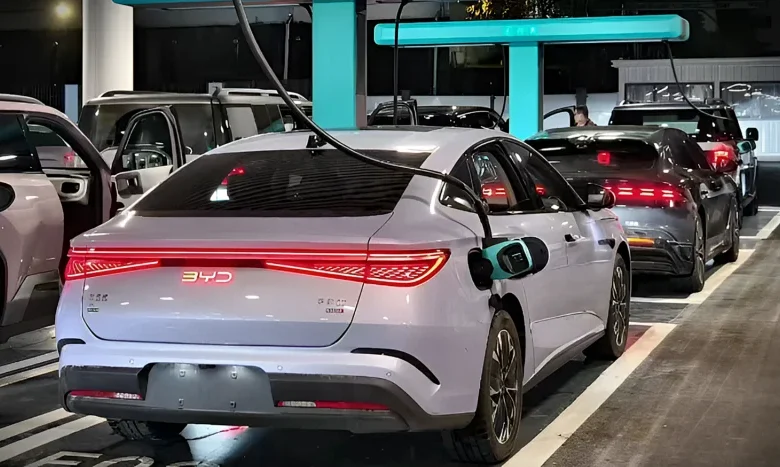
byd has been conducting internal megawatt-class flash-charging tests in Shenzhen that, if validated, would upend current fast‑charging norms. Images and on-site reports describe a forecourt-like demo station, a live Flash Charging app, and charging cabinets advertised up to 1, 500 kW — a striking escalation in peak power that accompanies a scheduled tech event on March 5 (ET) focused on a second‑generation blade battery and megawatt flash charging.
Byd testing and background
Leaked nameplate images and demonstration-site photos show infrastructure built around a 1, 000 V electrical architecture with peak output ratings as high as 1, 500 kW and a current capability of 1, 500 A. The test site layout resembled a fuel forecourt, equipped with liquid‑cooled charging guns and T‑shaped gantry structures. Access during the most recent session was limited to vehicles carrying a “Flash Charge” rear badge, naming models such as the BYD Tang 9, Song Ultra, Seal 07, Denza Z9 GT and FCB Tai‑series.
Charging hardware at the demonstration was reportedly configured to accept more than 1, 000 kW of input power and was set to automatically cut off at 97% state of charge. Screenshots show an Android Flash Charging app capable of nearby station search and automatic plug‑and‑charge activation, with charging initiating roughly 10 seconds after plug‑in. Displayed pricing at the site split 1. 3 yuan per kWh into 1. 0 yuan for electricity and 0. 3 yuan for a service fee, an amount presented as roughly 0. 18 USD per kWh. Buyers of compatible flash‑charge vehicles were shown as eligible for 1, 000 kWh of free electricity annually, though formal policy documentation had not been published at the time of the demo.
Deep analysis: technical limits, vehicle readiness and economics
The jump to megawatt charging raises three tightly coupled technical questions: sustained peak power delivery, the vehicle architectures that can absorb such power, and the economics of a new public charging tier. The leaked hardware sits in the 1, 360–1, 500 kW window, roughly triple the 500 kW peak power currently associated with one competitor’s latest V4 Superchargers deployed in China and well above the 250–600 kW range common for many public DC fast chargers. That scale implies a 1, 000 V backbone and aggressive thermal management — the demo’s liquid‑cooled guns and large cabinets underscore how thermal and electrical engineering constraints are being addressed at the station level.
Vehicle acceptance is equally critical. The demonstration limited chargers to cars capable of more than 1, 000 kW input, suggesting new or heavily upgraded battery packs and on‑board electrical systems to match the power. The second‑generation blade battery billed for the March 5 event is said to raise energy density while preserving safety and to support pure electric ranges above 1, 000 kilometers; if that battery chemistry and pack architecture scale as suggested, the combined effect would be longer single‑charge range plus much faster replenishment of miles per minute during a flash charge session.
On economics, the demo price point of 1. 3 yuan per kWh frames a service model that includes explicit non‑energy fees; the free annual kilowatt‑hour allowance for compatible buyers hints at vehicle‑led incentives to seed station usage. The current phase remains internal testing, and verified operational metrics — including sustained peak power curves, five‑minute range recovery data, and large‑scale rollout timelines — were expected to be disclosed at a future launch event.
Expert perspectives and regional impact
Deutsche Bank wrote in a research note that the second‑generation megawatt charging system is likely to enhance product competitiveness for the company behind the tech, and the bank projected a rebound in full‑year sales tied to these advances. The company has reportedly already begun large‑scale installation of megawatt flash‑charging piles, installing cyan, T‑shaped facilities in February as part of a buildout that could target more than 4, 000 self‑operated flash‑charging stations and cooperation networks exceeding 15, 000 locations, including third‑party partners.
Operational rollout will shape regional networks differently: a dense urban area can justify higher‑power forecourt sites serving compatible models, while regions with fewer compatible vehicles may see slower adoption. The station architecture — automatic plug‑and‑charge with rapid authentication and a near‑instant start — aims to mimic the convenience of liquid‑fuel refuelling, but the real test will be interoperability, station uptime under megawatt stress, and whether partner fleets or public chargers will upgrade at scale.
Looking ahead
The current disclosures and on‑site demonstrations frame an ambitious strategy: pair a higher‑energy‑density blade battery with megawatt flash charging and a new dealer and station footprint. Technical demonstrations indicate that byd is pushing both fast replenishment and extended range simultaneously, but validated performance curves and a concrete national deployment timetable remain outstanding. Will byd translate lab and demo megawatt figures into reliable, widely available infrastructure that reshapes charging economics and driver behavior? The March 5 (ET) tech event is positioned as the moment for the company to move from teasers and test rigs to verifiable metrics and a defined rollout plan.