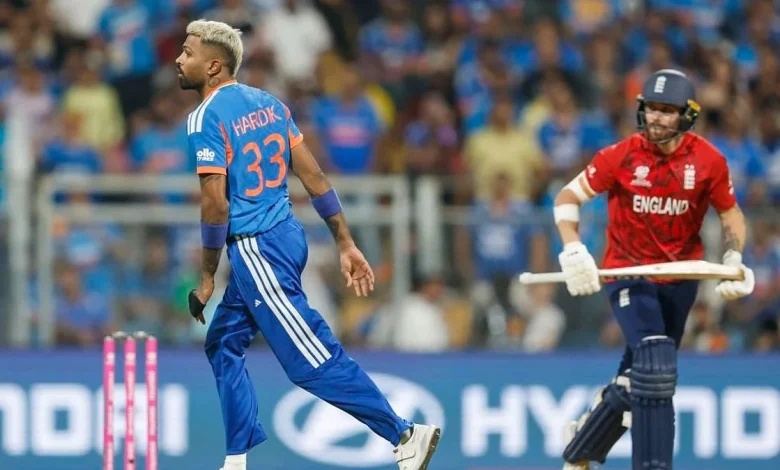
phil salt was dismissed in the powerplay of the India vs England ICC T20 World Cup 2026 second semi-final at the Wankhede Stadium, a breakthrough delivered by Hardik Pandya in his first over. The wicket was one of two instances in the tournament where Hardik struck in his opening over; the other came against Sahibzada Farhan in the group stages.
What Happens When Phil Salt Falls Early?
The early scalp shifted the immediate shape of England’s chase. England were 13 when the catch was completed; the dismissal came after an Arshdeep Singh over that yielded 13 runs, and captain Suryakumar Yadav handed the next over to Hardik Pandya. Hardik’s fullish delivery swung away, Salt edged to the cover fielder and Axar Patel completed the catch. Jasprit Bumrah later removed Harry Brook, and Varun Chakravarthy dismissed Jos Buttler, leaving the chase framed by a series of top-order blows.
- Match venue: Wankhede Stadium.
- India posted 253/7 in 20 overs; England were set to chase 254.
- Sanju Samson scored 89 off 42 balls (8 boundaries, 7 sixes); he was on 15 when dropped by Harry Brook earlier.
- Ishan Kishan made 39 off 18; Abhishek Sharma 9 off 7; Shivam Dube 43 off 25; Hardik Pandya 27 off 12; Tilak Varma 21 off 7.
- Hardik Pandya has taken a wicket in his first over twice so far in the 2026 T20 World Cup.
What If India’s Powerplay Plan Continues?
Force-field elements behind the pattern are explicit in this match. Since the Asia Cup 2025, India’s XI choices have tended to include either an additional batter or an additional spinner—Kuldeep Yadav or Arshdeep Singh appearing in those roles—allowing Hardik to operate as a second or third seamer in the powerplay. Hardik has adapted his approach: in addition to short-of-length and bouncer options, he has developed outswing and change-of-pace deliveries designed to be both economical and wicket-taking up front. From those mechanics emerge three mapped scenarios moving forward.
Best case — India’s powerplay blueprint replicates hereafter: new-ball overs produce early wickets from Hardik and the pace group, placing opponents on the back foot while the India batting engine provides match-defining totals like the 253/7 seen in this semi-final.
Most likely — Hardik continues to operate as a strike option in the powerplay, delivering the occasional immediate breakthrough (as versus Sahibzada Farhan and phil salt). Opponents will still find moments to recover, but India’s selection flexibility—extra batter or a specialist spinner—keeps the balance tilted toward varied match plans.
Most challenging — Opposing sides adjust to the outswing and change of pace, or recover quickly after early losses; the margin for error narrows if the new-ball plan yields runs instead of wickets, and big totals like India’s 253/7 become harder to set or defend.
Each scenario is anchored to the match-level facts: the method of dismissal, the bowling sequence (Arshdeep then Hardik), and the batting contributions that built India’s total.
What to watch next: whether Hardik’s first-over strikes become a recurring match hinge and whether teams change their tactics when England-style top orders meet a powerplay seamer who can swing the ball and alter pace.
For readers tracking momentum into subsequent fixtures, the key signals are clear—India’s selection choices and Hardik’s new-ball skillset are now a replicable axis of influence on matches, and the dismissal of phil salt is a case study in how that axis can tilt a semi-final’s early balance.