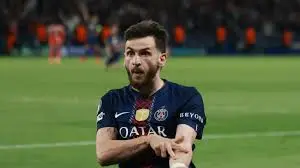
Hakimi was still on the pitch when the match slipped into its final, frantic minutes, but he was no longer moving like a full participant. That detail matters because this was not only a 9-goal semifinal; it was also a game that ended with one team running out of changes, a defender in visible discomfort, and a closing spell shaped by physical limits as much as by tactics.
What did the final minutes reveal about Hakimi?
Verified fact: the match in Paris finished with PSG winning a semifinal that produced nine goals, a total described as a historic night for the competition. In the closing phase, Hakimi was seen returning but unable to run properly, then remaining on the right side “to make up the numbers” while PSG had no substitutions left. He later went to the touchline to be attended to, and the account said he seemed to have suffered a muscular injury.
Analysis: the key issue is not just that Hakimi was hurt, but that PSG had already reached the point where it could not replace him. That changes the meaning of the final minutes. A team can survive pressure; it is harder to do so with a player effectively reduced to a placeholder. In a match decided by millimeters and late clearances, a compromised defender becomes part of the result even when he does not touch the ball.
How did PSG’s lack of changes shape the ending?
Verified fact: the final stages featured Bayern pushing for an equalizer, a corner that became the last major chance, and Safonov making an important intervention before the whistle. The same closing sequence also included a PSG counterattack in which Mayulu hit the crossbar. Earlier in that spell, PSG had already made changes, including Lucas Hernández and Mayulu coming on, while Bayern also adjusted its lineup.
Analysis: the broader pattern is clear: the match did not end in control, but in exhaustion. PSG conceded possession and dropped deeper as Bayern chased the score, while the home side relied on narrow defensive actions and limited outlet play. In that context, Hakimi’s condition was not an isolated medical note. It was part of a larger picture in which PSG’s margin for error shrank because one of its wide defenders could no longer function normally and no replacement remained available.
Why does the penalty debate matter to the larger picture?
Verified fact: the semifinal also included a contentious penalty episode involving Willian Pacho and Luis Díaz. One named arbitrating analysis concluded that the decision should not have been a penalty and even suggested it could have been an attacking foul, because Luis Díaz first made contact with his studs on Pacho’s leg. The same context states that the referee and VAR, with Del Cerro Grande involved from the video booth, awarded the spot-kick.
Analysis: the dispute over that call and the late injury to Hakimi point to the same underlying truth: this was a match where detail overpowered narrative. One contentious decision, one muscular issue, one blocked counterattack, one last clearance — each became decisive because the game was so open and so finely balanced. That is why the conversation cannot stop at the scoreline. The final is being remembered not only for the number of goals, but for how many turning points were compressed into the last moments.
Who benefited, and who was left exposed?
Verified fact: PSG emerged with the victory and Bayern left with a promising return leg still to play. The closing phase showed PSG defending under pressure, while Bayern chased the draw with direct play and repeated deliveries into the area. The match also produced yellow cards, repeated injury concerns, and a number of actions judged only by the smallest margins.
Analysis: PSG benefited from resilience, but it was not a clean form of control. It benefited from Safonov’s interventions, from the defensive effort around Pacho, and from Bayern missing its final equalizer. Yet the same evidence also exposes vulnerability: a defender in distress, no substitutions left, and a side forced to improvise at the edge of collapse. The night was triumphant on paper, but fragile in structure. That is the hidden cost of a game that felt historic while still leaving unresolved questions about decision-making and player availability.
Accountability question: if a semifinal can end with a visibly injured Hakimi being left on the field because PSG has no changes left, and with the most debated call still contested by named technical analysis, then the public deserves a clearer account of how such moments are managed. Not every dramatic match becomes a case study, but this one should. The evidence points to a game decided by thin margins, and hakimi stands at the center of that vulnerability.